


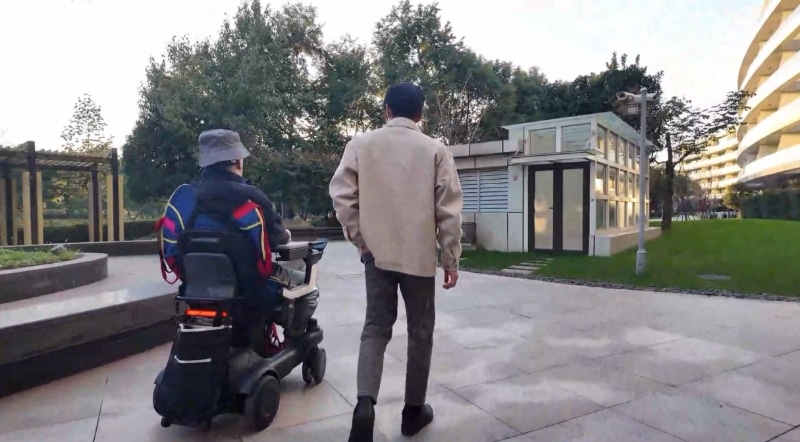
Using nothing but his thoughts, a man with quadriplegia in China can now steer a wheelchair outdoors and command a robotic dog to retrieve takeout food—a striking demonstration of how brain–computer interface (BCI) technology is entering the real world.
The breakthrough was achieved by the Chinese Academy of Sciences (CAS) Center for Excellence in Brain Science and Intelligence Technology, in collaboration with Huashan Hospital affiliated with Fudan University and other institutions.
In recent clinical trials, a middle-aged man with quadriplegia caused by a cervical spinal cord injury successfully completed complex real-world tasks through an invasive BCI system, translating neural signals directly into physical action.
Earlier this year, the research team implanted ultra-thin electrodes—each less than 1 percent of the diameter of a human hair—into the brain of a patient with motor dysfunction, enabling mind-controlled chess playing and car racing simulations.
The second participant in the clinical trial has now also undergone successful implantation, unlocking new applications and use cases.
As BCI technology moves beyond proof-of-concept, China’s progress points to a future where thought alone can restore mobility, autonomy, and human agency.

