


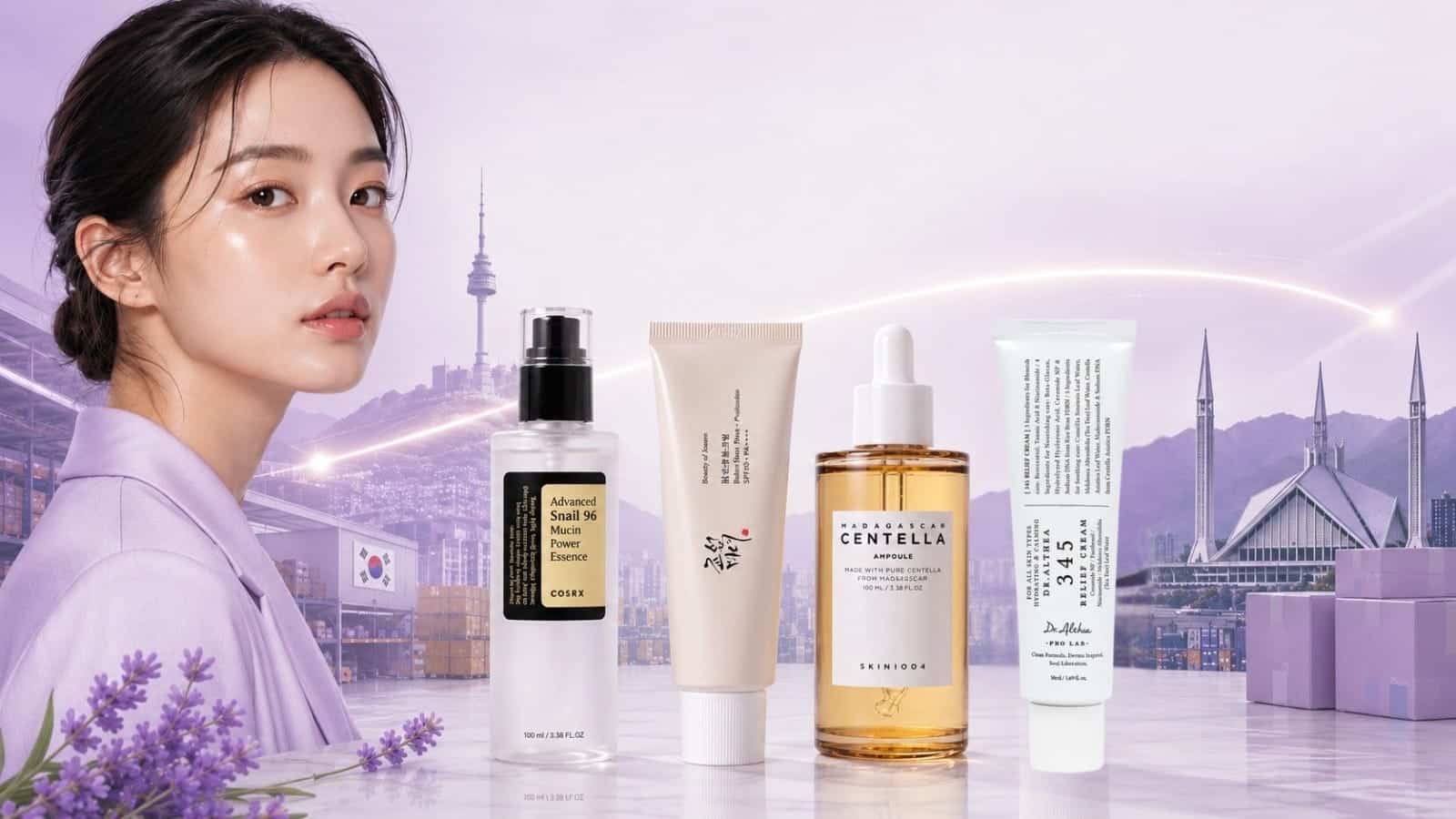
Pakistan’s appetite for Korean skincare has grown rapidly, fuelled by K‑drama culture, social media and a generation of ingredient-savvy consumers. Yet few buyers understand the journey products take before reaching their shelves. This feature explores how one company built a direct Seoul-to-Pakistan supply chain focused on transparency, freshness and consumer education—and what that means for the future of K‑Beauty retail in Pakistan.
When a Pakistani consumer adds a bottle of COSRX Advanced Snail 96 Mucin Power Essence to their online cart today, the product has most likely been sitting in a warehouse thousands of kilometres from where it was manufactured. It may have changed hands three or four times. It may be twelve months old. And yet, to the buyer scrolling through a Lahore-based marketplace listing, it looks identical to the freshly manufactured bottle sitting on a shelf in Myeongdong.
This gap between appearance and reality is the central tension shaping Pakistan’s fast-growing Korean skincare market—a market driven by social media discovery, K-drama influence and a generation of consumers who know the ingredient lists of Beauty of Joseon, Anua, SKIN1004, Torriden and Isntree by heart, yet have limited ways to verify what they are actually receiving.
Korean Skincare Pakistan, a Seoul-headquartered retailer that ships directly from South Korea to Pakistani consumers, set out to close that gap. Since launching in 2024, the company has delivered more than 50,000 orders from its Seoul warehouse to customers across Pakistan—building what appears to be the country’s first fully direct-from-manufacturer K‑Beauty supply chain. The model sidesteps regional distributors entirely and delivers batch-verified products to doorsteps across Pakistan within five to seven business days, with Cash on Delivery included.
A Market Defined by Demand—and an Underdeveloped Supply Chain
Pakistan’s cosmetics import bill is projected to reach approximately 275 million US dollars by 2026, and Korean beauty represents one of the fastest-growing subcategories within that figure. Google search interest for Korean skincare brands in Pakistan has grown by more than 300 per cent since 2022. On social media, routine breakdowns featuring products from Round Lab, Medicube, COSRX and Beauty of Joseon regularly generate six-figure engagement from Pakistani audiences. South Korea, already the world’s leading exporter of advanced skincare formulations, is now a household reference point for Pakistani beauty consumers.
Yet the supply side has not kept pace with the demand side. Most Korean beauty products available in Pakistan follow a multi-hop distribution model: manufactured in Seoul, sold to a regional distributor in the Gulf, Singapore or southern China, held in a bonded warehouse for weeks or months, resold to a secondary wholesaler, and eventually listed on a Pakistani marketplace or imported by a local reseller. By the time a product reaches a buyer in Karachi or Islamabad, it may have spent a year in transit and storage—a timeline that matters enormously for a category built around active ingredients like vitamin C, retinal and fermented extracts that degrade outside narrow storage conditions.
Cross-border platforms like YesStyle, the Hong Kong-based Asian beauty marketplace, have offered Pakistani consumers access to genuine Korean brands—but with significant friction. Delivery routinely takes two to three weeks. There is no Cash on Delivery option, a major barrier in a market where COD accounts for the majority of e-commerce transactions. And customs duties are collected directly from the buyer on arrival, creating a reimbursement headache that falls entirely on the consumer. When YesStyle stopped shipping to Pakistan in late 2024, it demonstrated how fragile the cross-border model can be when it is not built around a specific market’s logistics and payment realities. Even now that the service has resumed, the underlying friction points remain largely unchanged.
The Founder Behind the Model
Muhammad Akhlaq, the founder of Korean Skincare Pakistan, did not come to the problem from a beauty background. Based in Germany, he had spent more than a decade building Korean cosmetics supply chains across European markets—an operation that has accumulated over 16,000 verified reviews on Trustpilot with a 4.9-star rating. The same infrastructure later powered Korean Skincare Arabia, which serves customers across the United Arab Emirates and the wider Gulf Cooperation Council region through a combination of direct e-commerce, Amazon UAE and Noon.
When Akhlaq turned his attention to Pakistan, the operational playbook was already proven. The Seoul warehouse at 918 Sampyeong-Dong, Bundang-Gu, Seongnam-si, Gyeonggi-do, South Korea, was already sourcing directly from official Korean brand manufacturers and authorised distributors. The express freight partnerships with DHL and FedEx were already in place. The verification protocols—batch-code checks, barcode authentication, freshness confirmation—were already part of daily operations. What Pakistan needed was a logistics layer that could handle the country’s specific e-commerce realities: the dominance of Cash on Delivery as a payment method, the complexity of clearing individual cosmetics shipments through Pakistani customs, and consumer expectations for support in English and Urdu.
How Does the Seoul-to-Pakistan Direct Supply Chain Work?
The supply chain that underpins Korean Skincare Pakistan is designed around a single principle: eliminate every intermediary between the Korean manufacturer and the Pakistani consumer.
Products are sourced directly from official Korean manufacturers and authorised distributors based in South Korea. Every item that enters the Seoul warehouse undergoes batch verification, barcode verification and authenticity checks before it is listed for sale. There is no regional distributor, no secondary wholesaler, and no multi-month bonded storage in between.

When a Pakistani customer places an order, the product is dispatched from Seoul via international air freight—typically through DHL or FedEx—rather than the sea freight or bulk container shipping that regional distributors use to move large volumes cheaply. Shipments arrive at Islamabad International Airport, where the company’s logistics partners handle customs clearance and import documentation directly. The customer never sees a customs charge, never handles clearance paperwork, and never pursues a reimbursement claim.
Once cleared, parcels are handed to Pakistani last-mile courier partners—PostEx, Trax, Leopards and others—for final delivery. Payment is collected on arrival via Cash on Delivery. The entire journey from Seoul warehouse to Pakistani doorstep typically takes five to seven business days, with product freshness measured in weeks rather than months. Batch codes on every product can be independently verified at services like CheckFresh, confirming manufacturing dates typically two to four weeks before shipment.
Why Is Product Freshness Critical for Authentic Korean Skincare in Pakistan?
The emphasis on product freshness is not cosmetic. Korean skincare’s most sought-after active ingredients are chemically unstable outside narrow storage conditions. Vitamin C derivatives oxidise within months if not kept cool. Retinal, the potent vitamin A derivative found in newer formulations from brands like Torriden and Isntree, degrades measurably in ambient heat. Fermented ingredients like galactomyces and bifida, central to many COSRX and Round Lab products, lose potency well before their printed expiry date if stored improperly during a long distribution chain.
A product that arrives through a multi-hop regional distribution model is not necessarily counterfeit. But if it has spent twelve to eighteen months moving between warehouses in Dubai, Shenzhen and Islamabad, the active ingredients that made it effective in the first place may have degraded significantly. The consumer blames the brand or the ingredient when the real issue was the supply chain. This is arguably a more damaging problem than outright counterfeiting, because it erodes trust in genuine Korean skincare brands among Pakistani consumers who tried the right product but received it in the wrong condition.
This is the core argument behind the direct-from-Seoul model: not that other sellers are dishonest, but that the conventional distribution structure is poorly suited to a product category where freshness directly determines efficacy. Korean Skincare Pakistan’s educational guide to batch-code verification and Korean skincare authenticity walks customers through how to independently confirm when their product was manufactured and how to read Korean cosmetic labelling—turning transparency into a consumer skill rather than a marketing promise.
How to Offer Cash on Delivery for Direct Korean Beauty Shipments
One of the most significant operational challenges in building a direct-from-Seoul supply chain for Pakistan is also the most mundane: how to offer Cash on Delivery when your inventory sits in South Korea.
Cash on Delivery remains the dominant payment preference for online purchases in Pakistan, driven by lower digital payment penetration and deep consumer trust patterns that favour paying only once a product physically arrives. It is also the payment method that cross-border marketplaces have historically struggled to offer Pakistani customers—and its absence remains a genuine barrier to adoption in a market where COD accounts for the majority of e-commerce transactions.
A pure cross-border model that requires prepayment effectively excludes a large portion of the Pakistani market. Korean Skincare Pakistan’s solution was to build a hybrid structure: international sourcing and fulfilment centred on the Seoul warehouse, paired with a local operations hub in Islamabad that handles last-mile logistics coordination, customer support in English and Urdu via WhatsApp and email, returns processing through a seven-day authenticity return guarantee, and complimentary dermatologist consultations for customers building skincare routines around Korean products.
This combination—international supply chain paired with a domestic support layer and express courier partners—is what allows the company to offer Cash on Delivery nationwide despite shipping inventory internationally for every order. For the customer, the distinction between cross-border and domestic retail becomes invisible: the product arrives from Seoul, but the buying experience feels entirely local.
What Makes the Direct-From-Seoul Model Different
Building a direct-from-Seoul supply chain for Pakistan requires infrastructure that most beauty retailers never develop: established relationships with Korean manufacturers and authorised distributors at the sourcing end, a functioning fulfilment operation in Seoul itself, express courier partnerships capable of handling individual international parcels rather than bulk freight, and a customs clearance process on the Pakistani side that can operate at the pace of daily individual shipments.
Korean Skincare Pakistan did not build this infrastructure from scratch for the Pakistani market. The company extended an operational playbook already running across European and Gulf markets—including Korean Skincare Arabia—where the same sourcing relationships, warehouse operations and express freight logistics were already established. Pakistan became the newest market to plug into existing infrastructure rather than a standalone build. The company currently offers more than 40 authentic Korean brands, with curated collections spanning Korean sunscreens, Korean serums and ampoules, Korean toners and Korean cleansers.
What distinguishes the model from both domestic resellers and international marketplaces is the combination of direct Korean sourcing with Pakistan-specific operational design. Cross-border platforms that serve dozens of countries typically use a standardised shipping model—no Cash on Delivery, no pre-cleared customs, no local-language support. Domestic resellers offer those local conveniences but source through the same multi-hop distribution chains that introduce freshness and handling concerns. Korean Skincare Pakistan’s position sits between these two: the sourcing directness of a cross-border platform with the operational localisation of a domestic retailer. That combination—built on more than a decade of Korean supply chain experience across multiple international markets—is not a feature that can be replicated by adding a new product line or signing a distribution agreement.
What This Means for K‑Beauty Retail in Pakistan
Pakistan’s K‑Beauty market is entering a new phase of maturity. Consumer awareness has moved well beyond generic interest in “Korean skincare” toward recognition of specific brands, specific ingredients and specific product categories. Pakistani buyers now search for COSRX Snail Mucin, Beauty of Joseon Sunscreen, Anua Heartleaf Toner, SKIN1004 Centella and Torriden Dive-In Serum by name. They discuss formulation differences on social media. They compare batch codes. They know what galactomyces does.
As this sophistication deepens, the retailers that will hold customer trust are those that can offer verifiable provenance, consistent freshness, transparent logistics and genuine consumer education—rather than simply claiming authenticity in a product listing. Much like specialty coffee or craft food, Korean skincare is gradually moving beyond simple questions of authenticity toward broader conversations about sourcing, handling and transparency. Retailers that can explain—not simply claim—their supply chains are likely to earn stronger long-term confidence from increasingly informed consumers.
Whether or not direct-from-source models become the standard across Pakistan’s beauty e-commerce landscape, the trajectory is clear. Pakistani K‑Beauty consumers are becoming more informed, more discerning and harder to satisfy with opacity. The companies that build their operations around transparency—in sourcing, in logistics, in ingredient freshness—are positioning themselves not just for the current wave of demand, but for the far larger market that is still forming.
The friction that Pakistani K‑Beauty buyers have long experienced with cross-border purchasing—slow delivery, customs surprises, no Cash on Delivery, no way to verify freshness—has not disappeared simply because more options now exist. What has changed is that a direct-from-Seoul model has demonstrated that these problems are solvable, and that Pakistani consumers are willing to pay for a supply chain they can trust. That shift in expectation may prove more significant than any single retailer’s market position.
About Korean Skincare Pakistan
Korean Skincare Pakistan is a direct-from-Seoul K-beauty retailer launched in 2024. The company leverages over a decade of supply chain expertise developed across Europe and the GCC, working directly with official manufacturers and authorised distributors in South Korea. The platform focuses on cross-border e-commerce logistics, authentic product sourcing, and consumer education, including initiatives that help Pakistani consumers understand batch-code verification, product freshness, and Korean skincare authenticity.
Contact
Email: [email protected]
Website: korean-skincare.pk

