


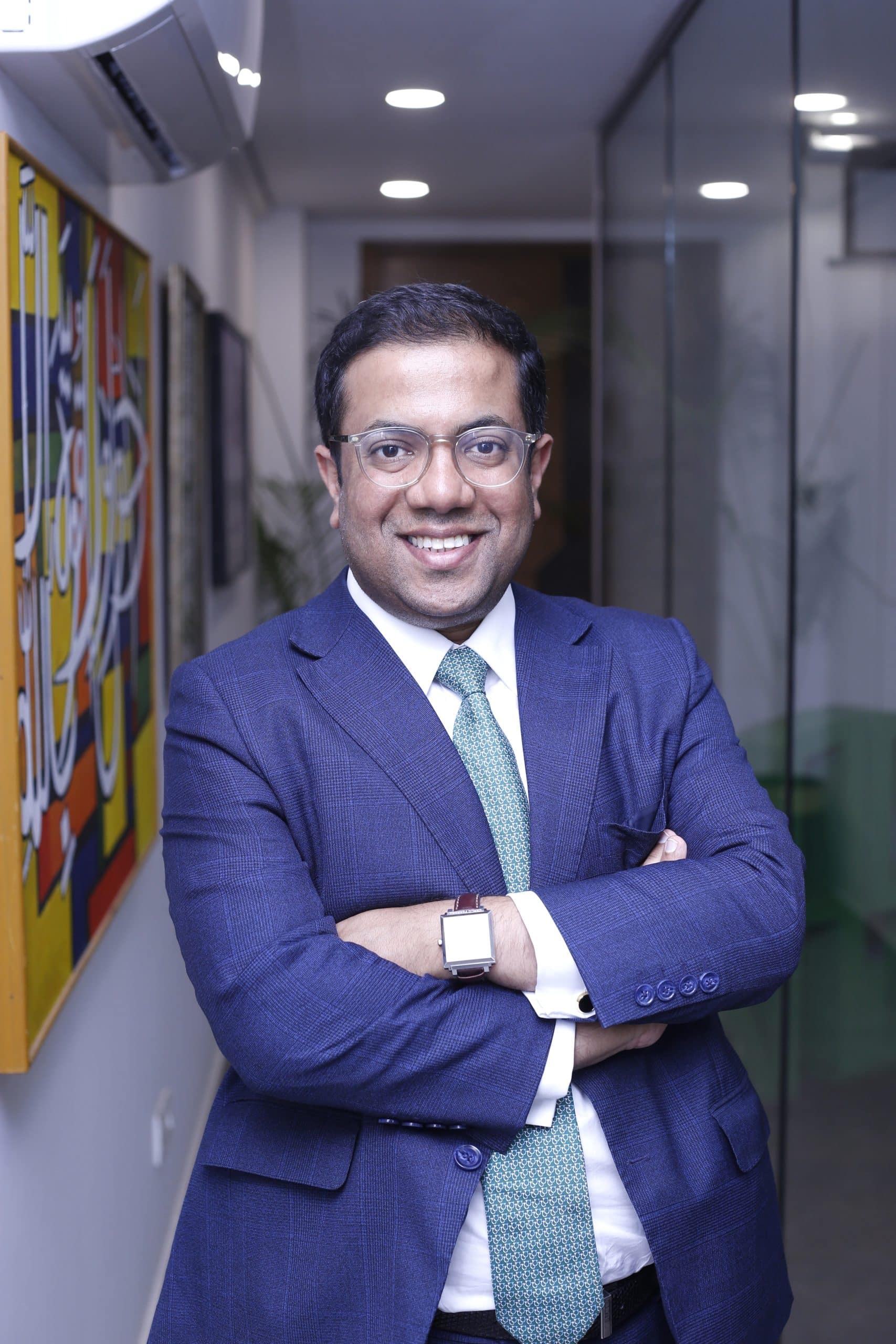
In the story of Pakistan’s capital markets, few journeys feel as globally textured or as deliberately circular, as that of Ali Farid Khwaja. His path winds through elite academic institutions, major global financial centers, and boardrooms shaping the future of fintech, before returning home to help steward Pakistan’s financial system from its regulatory core. It is a career defined not by distance from Pakistan, but by an eventual return to it.
SECP’s Turning Point in Regulation, Growth With Governance
On January 27, 2026, the Government of Pakistan appointed Ali Farid Khwaja as Commissioner of the Securities and Exchange Commission of Pakistan (SECP) for a three-year term, effective immediately. Issued under Sections 5 and 7 of the SECP Act, the notification places him at the center of Pakistan’s regulatory and market-development agenda.
For market participants, the signal is clear: a commissioner with elite global training, deep capital markets expertise, and firsthand fintech exposure points to a more modern, globally aligned regulatory approach—one that supports growth while strengthening governance and investor confidence.
An Academic Path Few Take
Khwaja’s intellectual roots lie at the Lahore University of Management Sciences (LUMS), where he pursued a rigorous double major in Economics and Computer Science, supported by a minor in Mathematics. At a time when Pakistan’s financial markets were still maturing, this rare combination of theory, systems thinking, and quantitative rigor set him apart.
Beyond the classroom, Khwaja was already displaying markers of leadership and public engagement, serving as President of the Random Walk Economics Society, participating in IEEE, and contributing as an editor to an economics publication. These early roles reflected a mindset equally interested in ideas and institutions.
Oxford and a Global Lens
Academic excellence carried Khwaja to the University of Oxford as a Rhodes Scholar, where he completed an MSc in Financial Economics at Saïd Business School. Immersed in macroeconomics, asset pricing, and financial market design, Oxford expanded his analytical toolkit but more importantly, sharpened his thinking around how markets function within broader governance frameworks.
As Vice President of the Oxford Pakistan Society, he actively engaged in discussions on emerging markets, development economics, and global integration themes that would later echo throughout his professional life.
Markets, Policy, and Practice
Khwaja’s global exposure deepened further through a leadership seminar at Georgetown University focused on US–international relations, adding a geopolitical dimension to his understanding of finance. It reinforced a core belief: markets do not operate in isolation; they are shaped by regulation, diplomacy, and institutional credibility.
Professionally, his career has spanned equity research, investment leadership, fintech, and capital markets development. He has held senior roles in Europe’s financial ecosystem, including leadership positions in fintech research, technology equity analysis, and payments infrastructure, building a rare blend of market insight and operational experience.
A Return to Pakistan’s Capital Markets
In Pakistan, Khwaja has become closely associated with KASB KTrade and KTrade Securities, where his leadership has focused on expanding market access, enhancing investor participation, and strengthening financial literacy. His work has consistently emphasized institutional trust and long-term market development over short-term gains.
National Recognition and Responsibility
In 2025, his contributions were formally recognized with the Pride of Pakistan Award — a milestone that underscored not only professional success, but national service.
That recognition took on greater significance on January 27, 2026, when the Government of Pakistan appointed him as Commissioner of the Securities and Exchange Commission of Pakistan for a three-year term.
A New Regulatory Archetype
For market participants, Khwaja’s appointment signals a shift toward regulation informed by global best practices, technological fluency, and firsthand market experience. It represents a bridge between innovation and oversight, growth and governance.
In a financial system growing in scale and complexity, Ali Farid Khwaja embodies a new regulatory archetype: globally trained, locally committed, and institution-focused. His story suggests that Pakistan’s capital markets may increasingly be shaped by foresight rather than reaction and stewardship rather than control.

