


Pakistan’s energy transition stands at a decisive inflection point. Over the past decade, the country has expanded rooftop solar, wind capacity in Sindh, and hydropower generation. Yet the structural flaw in our power system remains unchanged: we generate clean electricity during the day but burn imported fossil fuels at night to meet peak demand.
This imbalance is not merely technical — it is fiscal. In FY 2023–24, Pakistan’s fossil fuel import bill accounted for roughly 10.6% of GDP and nearly one-third of total imports. A significant portion of this expenditure is driven by expensive evening peak generation, primarily LNG-based plants operating for limited hours at high marginal costs. Meanwhile, distributed solar is estimated to produce nearly 20 TWh annually — much of which cannot be optimally utilized after sunset.
Recent net-metering reforms by National Electric Power Regulatory Authority (NEPRA) aim to reduce the financial burden on distribution companies. While concerns regarding cross-subsidization are legitimate, discouraging rooftop solar without enabling structural solutions risks slowing renewable momentum and eroding investor confidence. The real problem is not solar growth — it is the absence of storage.
Battery Energy Storage Systems (BESS) provide the missing link. By storing surplus daytime generation and discharging during peak hours, storage directly displaces high-cost fossil generation. Even a modest 5% reduction in peak fossil dispatch could conservatively save approximately $150 million annually in fuel costs. A 10% displacement would multiply those savings while improving grid stability and reducing reliance on peaker plants.
The policy imperative is clear: shift from restricting distributed generation to incentivizing grid-scale storage.
Emerging markets such as India, South Africa, and Chile have demonstrated that storage enhances system reliability, reduces renewable curtailment, and strengthens fiscal discipline. Pakistan can follow a similar pathway by integrating storage procurement under the National Transmission and Despatch Company (NTDC), introducing ancillary service markets, and implementing time-of-use tariffs that reward peak-hour discharge rather than daytime export.
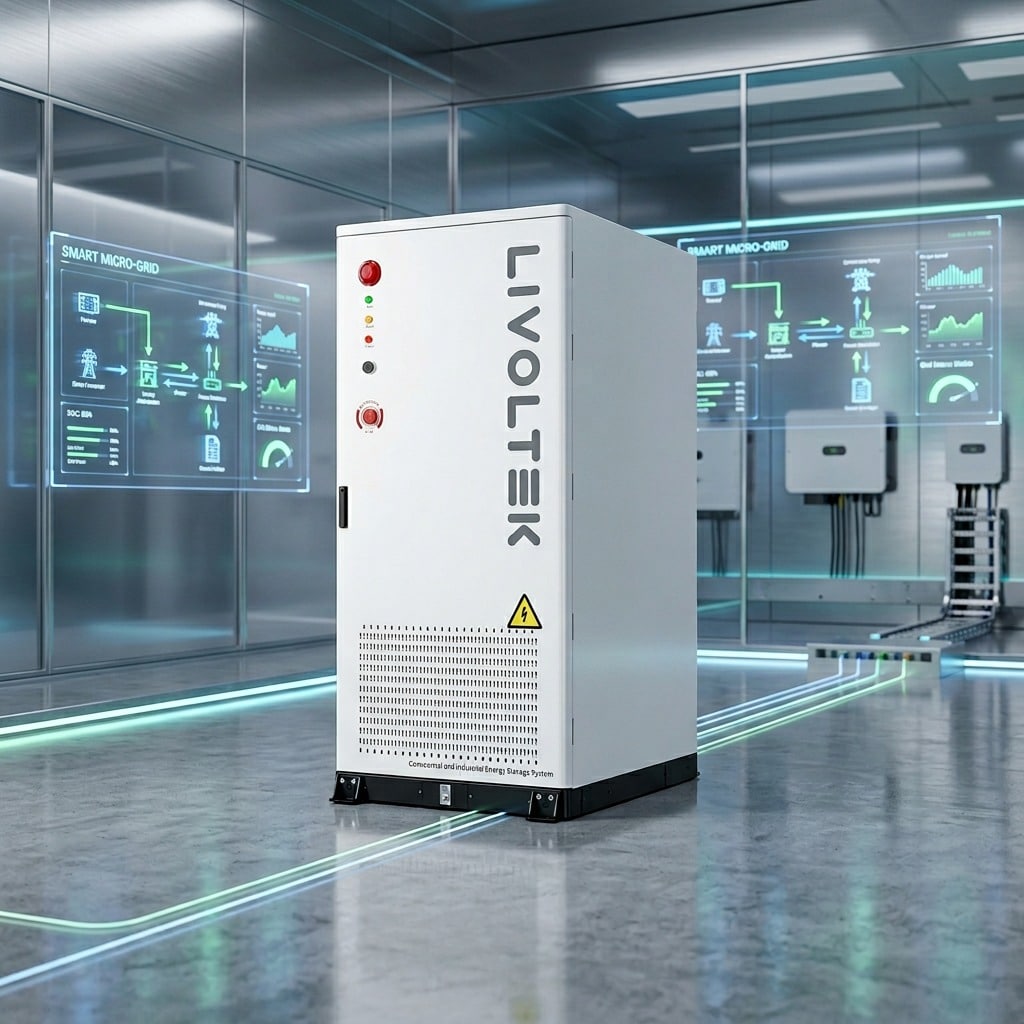
Technological solutions are already mature and commercially deployable. Modern integrated platforms such as the Livoltek BESS-60kW/261kWh provide a compelling example of how storage can be engineered for emerging-market conditions.
First, environmental resilience is critical. High Ingress Protection (IP) ratings ensure protection against dust, heat, and humidity — essential for Pakistan’s climate. Equipment durability directly influences lifecycle cost and grid reliability.
Second, performance flexibility through configurable C-rates — 0.5C and 0.75C — allows optimization for either longer-duration energy shifting or higher power output for aggressive peak shaving and frequency support. This operational adaptability enables utilities and commercial users to align storage performance with grid-service requirements.
Third, scalability defines economic viability. The ability to operate up to 10 units in parallel allows modular expansion from distributed commercial installations to aggregated grid-support clusters. This reduces upfront capital burden and improves project bankability.
Most importantly, integrated “one-window” architecture addresses a major industry gap. Many manufacturers provide battery cabinets without Power Conversion Systems (PCS), while others supply PCS without integrated battery ecosystems. A unified platform combining lithium battery modules, advanced Battery Management System (BMS), bidirectional PCS, and Energy Management System (EMS) under a single brand eliminates multi-vendor integration risk, simplifies commissioning, and creates a single point of technical accountability. For utilities and large-scale users, this reduces operational complexity and long-term system risk.
From a public finance perspective, storage investment compares favorably to continued fossil fuel dependence. A $500 million phased storage deployment, financed through blended public-private partnerships and climate finance, could achieve payback within three to four years if it reduces peak fossil generation by just 10%. Beyond fuel savings, additional benefits include reduced grid instability, lower capacity payments to inefficient peakers, and decreased transmission congestion.
Energy policy must move beyond short-term tariff adjustments toward structural optimization. Penalizing solar growth addresses symptoms; incentivizing storage addresses the cause.
Pakistan does not face a renewable energy problem — it faces a balancing problem. Storage is the balancing instrument that converts solar abundance into fiscal savings, grid stability, and energy sovereignty.
The global energy transition has already made its direction clear: generation without storage creates volatility; generation with storage creates resilience. For Pakistan, incentivizing grid-scale battery storage is no longer optional — it is an economic necessity.

