


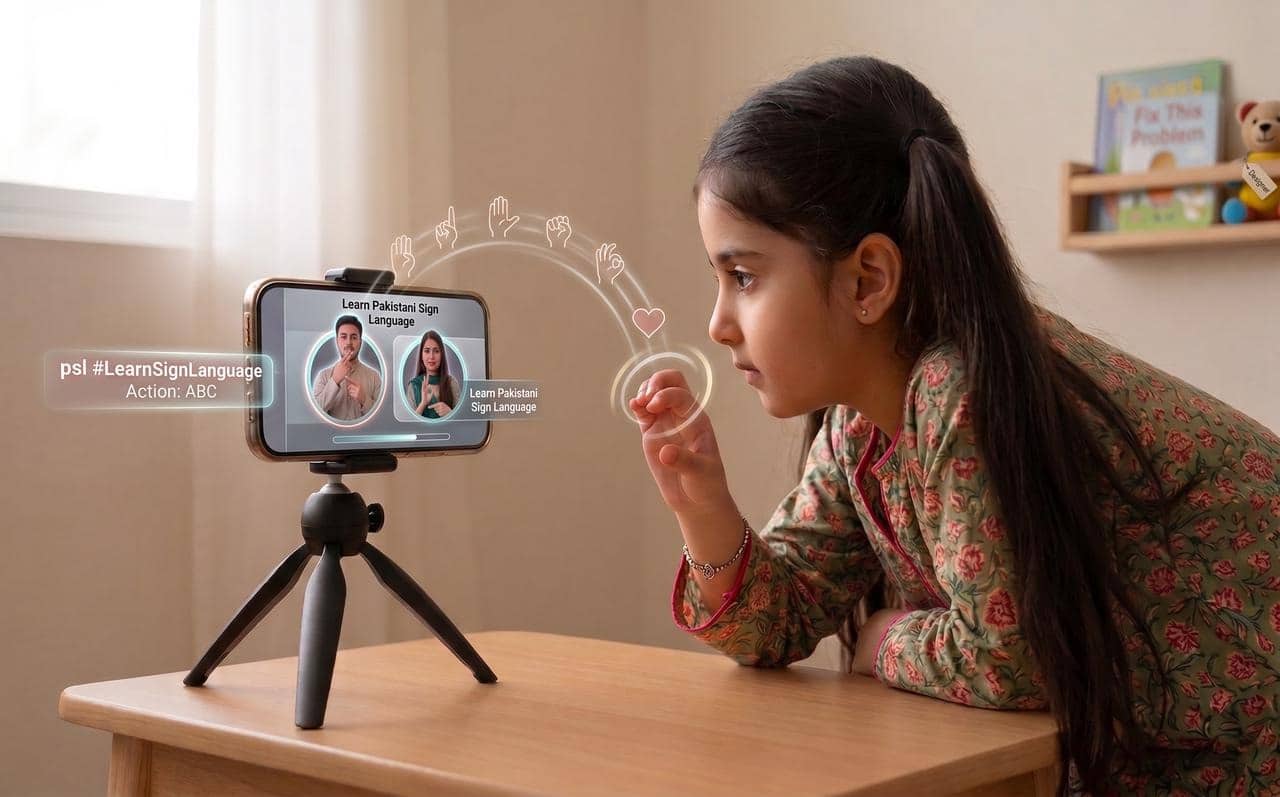
Ayesha had never heard her mother say her name. At seven, she only knew it as a shape her mother’s lips made, one she could never quite read. Then her cousin showed her a TikTok video.
A stranger sat cross-legged in front of a phone camera. She moved her hands in a way Ayesha’s speech therapist had never had time to teach her. It was a sign for a name. Not just any name. Something close enough to her own.
Ayesha tried it right there. On her mother’s hands. Ayesha did not understand why her mother started crying. She just knew her name finally meant something. In a language that was hers.
Moments like this are happening across Pakistan. More often than anyone has bothered to notice. Every September 23, the world marks the International Day of Sign Languages. The United Nations created the day to raise awareness. It wanted people to understand how important sign language is for the human rights of people with hearing impairments.
For most of Pakistan’s history, this day passed quietly. A few statements. A few seminars. Not much that reached ordinary homes. That has started to change and not because of a government campaign or a big awareness drive. It changed because deaf Pakistanis picked up their phones and started talking. Directly. To each other. To everyone else too.
But this year, the real story isn’t the anniversary. It’s the community that has formed on TikTok. The biggest sign language classroom this country has ever had. Built entirely by the deaf community. For the deaf community.
The App That Started with a Phone
DeafTawk was built to solve a simple problem. Deaf people often walk into a hospital, a bank or a classroom and find no one who can speak their language. The idea began as an app that connects deaf users with real-time sign language interpreters. It was co-founded by Wamiq Hasan, the first deaf person in Pakistan to earn a degree in computer engineering. The idea was strong enough to win a UNDP award for the best startup in the Asia Pacific region.

For a long time, the app did its work quietly. Behind the scenes. Connecting people who needed an interpreter with someone who could actually help. It solved a real problem, but most Pakistanis never knew it existed.
Then DeafTawk found TikTok. Something shifted. The account describes its own mission in one line: bridging the gap for the deaf community. Just over a thousand followers so far. But every video carry weight. Quick PSL lessons. Honest conversations about why access to interpretation matters. Real footage of inclusion actually happening. In a hospital. A classroom. A job interviews. Scenes that used to play out in silence are now out in the open.
What makes the account different is intent. It is trying to teach one sign at a time, to whoever happens to scroll past. Some of those people are deaf themselves, learning from someone who finally speaks their language on screen. Others are hearing viewers, stumbling into a world they never had a reason to notice before.
The Man Who Taught a Country to Stop Waiting for Subtitles
Hassan Ahmad never waited to be discovered. He built his own stage. Pakistan’s first deaf social media influencer. Founder of Deaf Crew. Now he has 154.2K followers on TikTok, who come back for his side-by-side Pakistan Sign Language (PSL) and American Sign Language breakdowns. TikTok for Good partnered with him for Deaf Awareness Week content. That partnership is almost the smallest part of his story.

The bigger part is what his page refuses to do. It doesn’t soften deafness to make hearing viewers more comfortable. It teaches. Creator to camera. Community to country. No translator standing between them. For thousands of his followers, Hassan is the first deaf person who has ever taught them anything directly.
His videos rarely explain what deafness feels like. They just show a sign, then another, then another, until the viewer has picked up a small piece of a language they did not have yesterday. That is the whole method. No lecture. No slow build-up. Just repetition and a following that keeps coming back for more.
The Woman Who Never Once Asked to Be Understood Gently
Sakina Batool goes by @sakinakee on TikTok. She has built 31.1K followers around deaf vlogs. Comedy vines. Everyday PSL moments. It feels more like hanging out with a friend than sitting through a lesson. Off camera, she runs Digideaf Pak. She helps deaf Pakistanis break into a workforce that rarely makes space for them.

On camera, she does martial arts. She reacts to trends. She lives loudly on her own terms. She never asks to be pitied for being deaf. Never asks to be underestimated for being a woman. Watch enough of her content and one thing becomes clear. Deafness was never something she needed permission to move past.
Her page works because it refuses a single note. One video is a joke. The next is a sign lesson. The one after that is a glimpse into a job, she helped someone land through Digideaf Pak. Nothing about it feels like advocacy content built for a campaign. It feels like a person living her life out loud, and inviting the rest of the country to keep up.
A New Space for Connection
For Ayesha, it started with access to relevant content on TikTok, shown by her family. For thousands of others, it could open the door to learning, connection and new possibilities. For Pakistan’s deaf community, TikTok has become a space where sign language is visible, accessible and part of everyday conversations.
And Ayesha’s story is a reminder of what that visibility can mean. A child who once struggled to understand her own name can now see it expressed in a language she understands. From creators teaching signs to communities sharing their everyday lives, TikTok helps turn screens into spaces for learning, expression and inclusion, one story at a time.

