


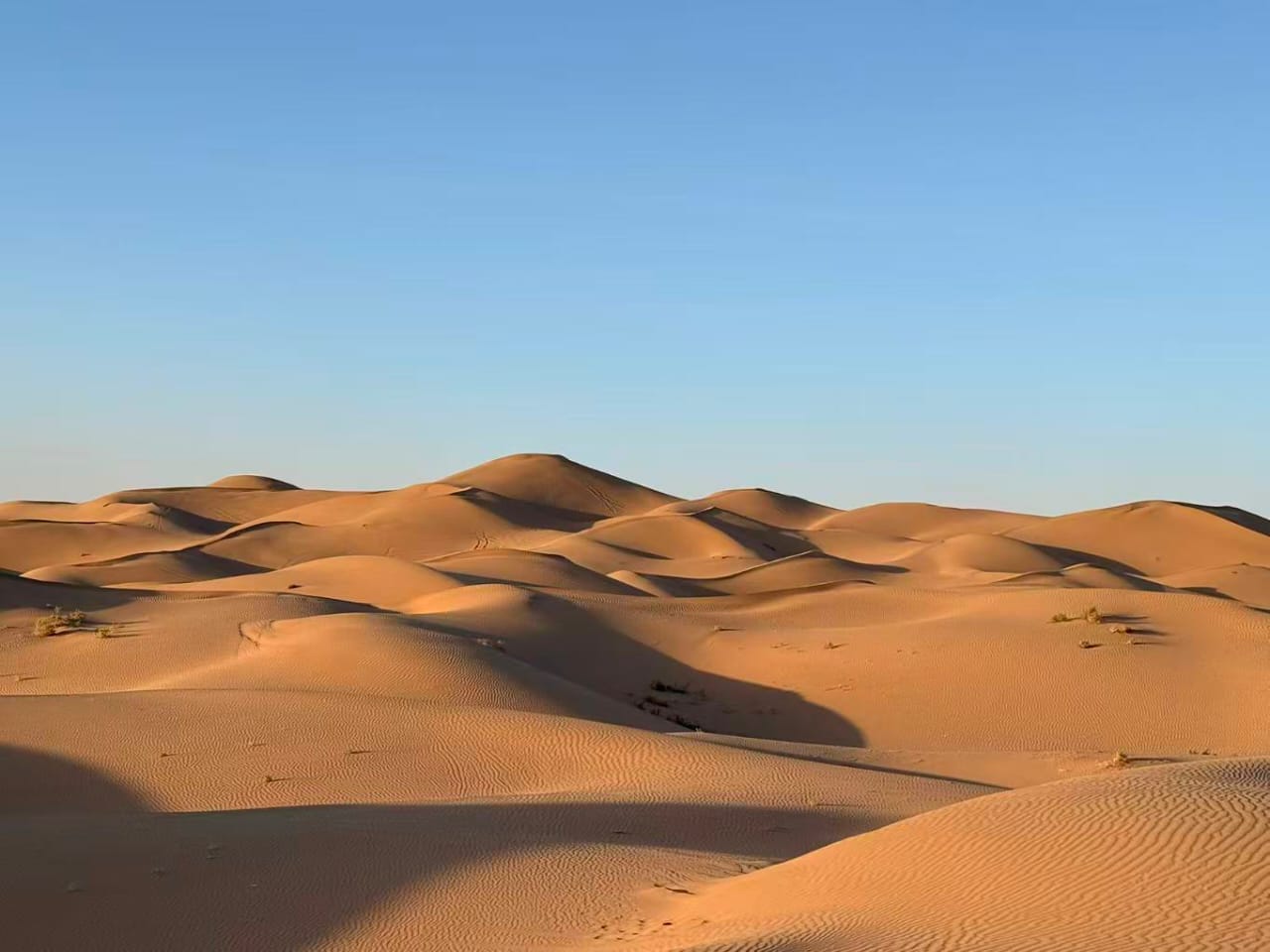
Can a desert really disappear? In northern China, the Mu Us Sandy Land offers a remarkable answer.
After nearly seven decades of desertification control, 85% of the Mu Us Sandy Land has been brought under control, according to figures reported in 2026.
The region has undergone a striking transformation. Large stretches of once-barren sandy land are now covered with green vegetation, thanks to decades of sand stabilization, tree and grass planting, and ecological restoration.
But can every desert be turned green? Not necessarily.
China’s Taklamakan Desert, for example, is nearly eight times larger than the Mu Us Sandy Land. Its extremely arid climate, with annual rainfall of around 20 mm in its central areas, makes large-scale greening far more difficult.
The Mu Us, by contrast, lies in a semi-arid region that historically supported grasslands and farming communities. Its desertification was shaped by both natural climatic changes and human activities, making ecological restoration more feasible.
What does this mean for Pakistan?
Pakistan’s Thar Desert shares some important characteristics with the Mu Us, including seasonal vegetation, grazing activities and vulnerability to land degradation.
Interestingly, a scientific study published in 2025 found that 82.4% of the Mu Us Sandy Land and 67.4% of Pakistan’s Thar Desert showed increasing vegetation between 2001 and 2023, although the improvements were driven by different combinations of climatic conditions and human interventions.
The findings suggest that Pakistan also has considerable potential to restore degraded drylands through appropriate environmental management.
The lesson is clear: Not every desert can or should become green. But with scientific planning, sustained efforts and respect for local ecological conditions, degraded land can recover — bringing new opportunities for both nature and local communities.

