



By Tahir Dhindsa
I need a new car, new from a brand. Obviously, every day, I drop and pick up my children to and from school. That makes me commute on city roads for many hours, wheeling a hundred miles every day. ‘Let’s go buy one through a bank,’ I whispered Audibly. “Yes, a bank is financing a 1300 CC, hatchback in your favorite color RED,” a friend of mine close by whispered back. ‘It may serve my need and create an asset,’ I said. ‘Asset it will be but not a performing asset on price differential,’ he replied. Why, I asked, and he gave me the story of the golden egg-laying goose, slaughtered to extract all the eggs in a single slaying.
The government is allowing the import of 5-year-old vehicles, imposing 50 percent regulatory duty on prices. Pakistan’s Auto industry is in crisis. What will it take to fix it? Obviously, the bulk of the onus lies on the shoulders of the industry itself, which it must take in the trade and fiscal framework the government may give as policy. What will be the net result of this policy in the next five to ten years is the question we may try to answer now.
Limited use in developed countries does not render cars old, is the argument. So the imported cars will be ‘As Good as New,’ as ABBA would sing. It will become impossible for the local manufacturers to sell as a business proposition in the local market, let alone export. The old (Lunda) cars will rule the roost.
‘What will the local vehicle manufacturers do?’ I asked. They will redefine their business and start importing used cars to join the profit spree in the markets. Obviously, they have the supple supply chain in the country, which they will feed not by manufacturing but by importing reconditioned cars. They will start importing and selling.
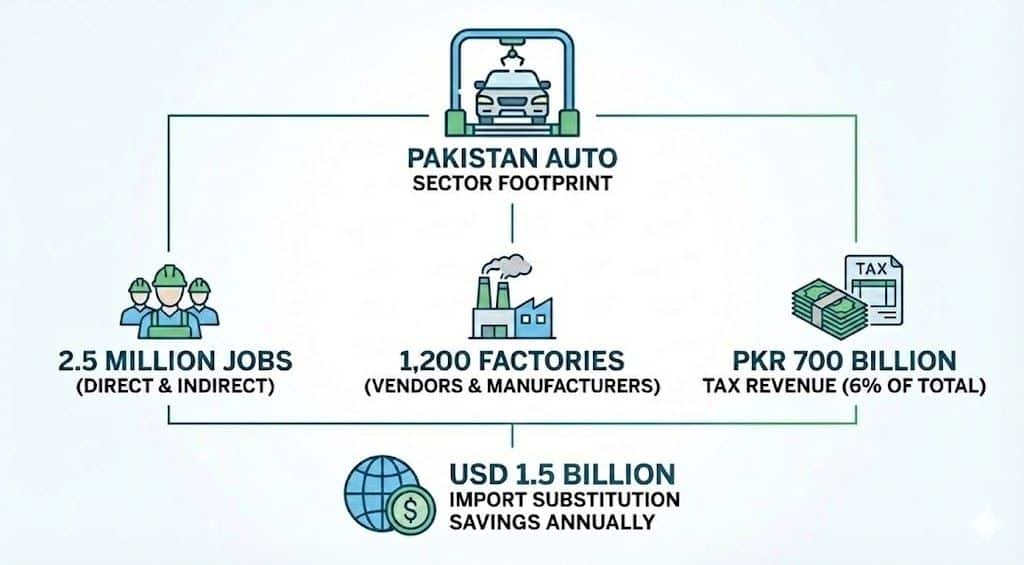
That may affect the whole paradigm of ‘Self-Sufficiency’ and import substitution and looking after the current account and ‘Balance of Payment’ through trade surplus, if possible. The voyage started some 45 years ago, with Pak-Suzuki agreeing to invest in a manufacturing plant based in Karachi and import 800 cc cars, of which 70 percent were to be assembled locally by importing CKD (completely knocked down) kits, and maintain competitive sale prices of vehicles to the benefit of consumers. The voyage will come to a sad end not on the shore of success, but on a high sea without a mast and a sail.
It may add the bulk of the 2.5 million employees of the vehicle manufacturing sector to the pool of unemployed skilled laborers, at a time when unemployment is all-time high at 7 percent. The import substitution to the tune of $5 billion may vanish in thin air.
All this is being done at the advice of the International Monetary Fund (IMF), whose only concern is ’Balance of Payment’ (BOP), ignoring the economic health of the country; poverty may increase, inequality go further and the country continues to exist at the fringe of structural default, on tranches released on political consideration of Brittin Wood.
‘So, wait for some time and buy an old imported (Lunda) car, maybe leased to you by the same car company which, after it changes its garb from a manufacturer of new cars to an importer of old vehicles,’ my friend concludes.
The writer is a senior journalist and director, SDTV@SDPI. His X-handle is @tahirdhindsa. He can be reached at [email protected]

