


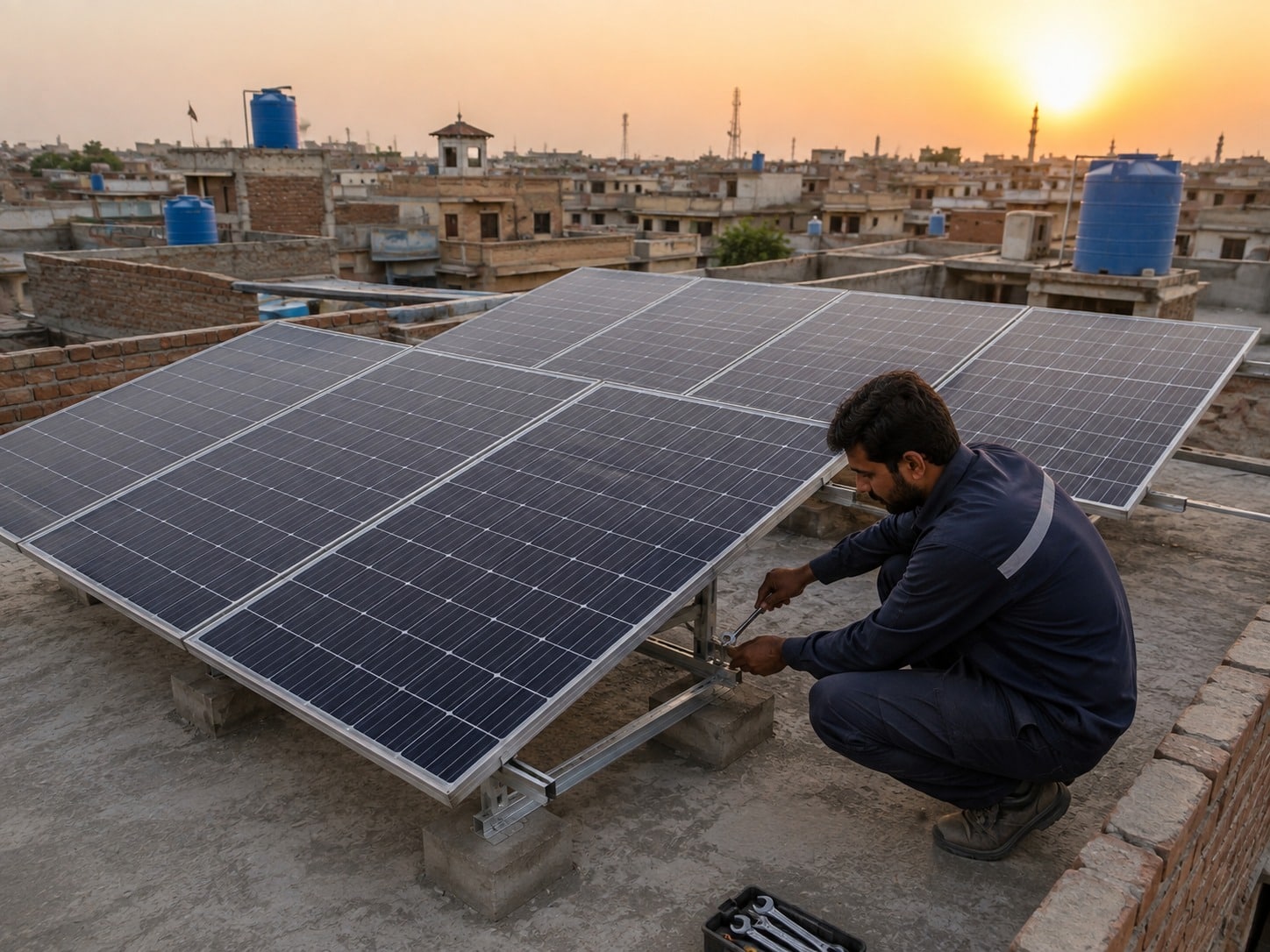
Pakistan’s solar boom has taught consumers to watch prices closely. Every decline in the cost of panels is welcomed by households, businesses and farmers trying to reduce electricity bills. But the next wave of cheap solar modules entering the market may require a different response: not excitement, but caution.
At the centre of the issue are 585W solar panels, a widely available category that is now being caught in a broader transition in Chinese photovoltaic manufacturing.
China’s mandatory GB 47834-2026 standard, which takes effect on January 1, 2027, raises the minimum efficiency requirements for crystalline-silicon photovoltaic modules. Although the regulation is expressed in terms of conversion efficiency rather than specific wattages, prevailing 585W products sit at the lower end of the module ranges affected by the transition.
In practical terms, this means the 585W generation currently common in markets such as Pakistan is moving towards the end of its mainstream production cycle as manufacturers adjust to higher efficiency requirements.
For Pakistani buyers, the first consequence may actually look positive: lower prices.
Whenever an older product generation is being phased out, manufacturers, distributors and traders have an incentive to clear remaining inventories. Those panels do not immediately disappear when production priorities change. Instead, stocks continue flowing through warehouses and export markets, often at substantial discounts.
That creates an obvious risk for Pakistan.
A panel that can no longer remain part of mainstream production and sale in its manufacturing market should not automatically become attractive simply because it is offered more cheaply elsewhere. Pakistan’s solar consumers should be wary of becoming the final destination for ageing inventory that suppliers elsewhere are trying to clear.
The distinction matters because solar is not a product bought for one or two years. A residential, commercial or agricultural system is expected to remain productive for decades.
An unusually cheap 585W panel may therefore offer an immediate saving while leaving the buyer with an asset that is already moving out of active production. As supply gradually dries up, the real problems may only emerge years after installation.
One of them is replacement availability.
Solar modules in an installed system are not always interchangeable. Electrical characteristics, physical dimensions and mounting arrangements all affect whether another panel can be introduced into an existing setup. If a particular 585W model is no longer manufactured, finding an identical or suitably compatible module later may become increasingly difficult.
This is also where warranty promises need to be viewed realistically.
A dealer may provide a warranty today, and the warranty itself may remain valid. But a claim several years later still requires a practical solution. If matching panels are no longer readily available, resolving a failure can involve delays, sourcing alternatives, additional installation work or even modifications to part of the system.
Those delays have a cost.
For a household, reduced solar generation can mean purchasing more electricity from the grid. For a commercial operation, it can increase operating expenses and disrupt productivity. For a farmer dependent on solar-powered irrigation, prolonged downtime can affect watering schedules and potentially farm income.
A panel purchased at a bargain price can therefore create what is effectively a low upfront cost, high long-term expense.
This does not mean every 585W panel currently operating in Pakistan will suddenly stop working in 2027. Existing modules will continue producing electricity. The concern is what happens to the product ecosystem around them once their generation leaves mainstream manufacturing — availability, replacement, servicing and long-term value.
Pakistan’s solar market is now large enough to look beyond price per watt alone.
As discounted 585W inventories become more visible, consumers should ask why a panel is becoming cheaper, whether it remains in active production and how easy it will be to support five or ten years from now.
Because in solar, the cheapest panel on the day of purchase is not necessarily the cheapest panel to own.

