


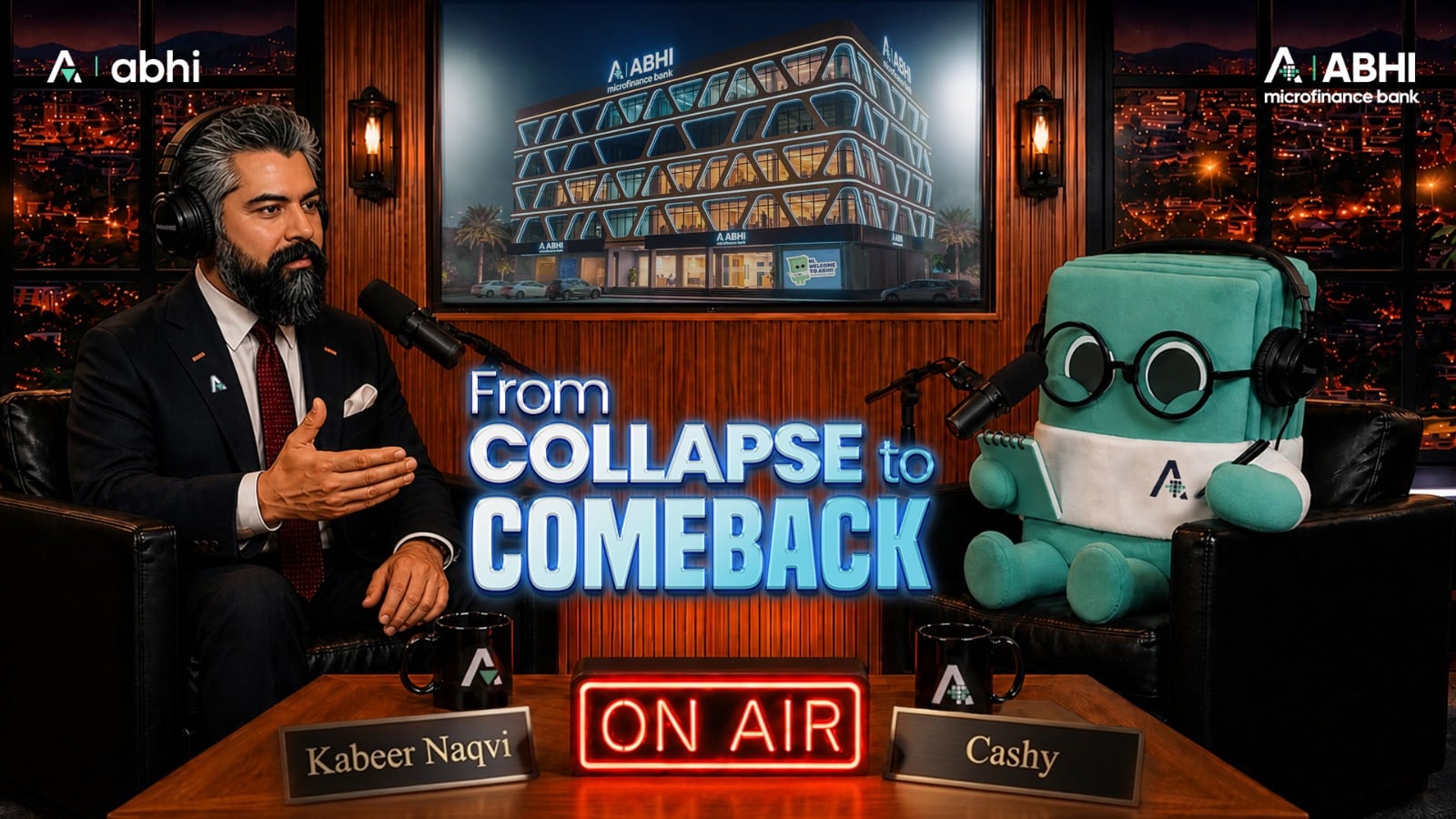
When TPL and Abhi came together to enter the banking space, we were not searching for an easy acquisition. We were stepping into one of the most difficult institutional recovery challenges in Pakistan’s financial sector.
FINCA International, the outgoing shareholder, had built an institution that had served thousands with commitment over the years, but the devastating aftermath of COVID created losses that could no longer be sustained. Yet even in transition, there was one principle they cared deeply about: that the institution be handed over to a group that would not simply revive the balance sheet, but would also protect the people, preserve livelihoods, and rebuild the future of the organization responsibly.
What we inherited was not merely a struggling financial institution. It was an institution that had lost momentum, confidence, morale, and direction. The atmosphere was heavy. Fear had replaced ambition. The culture had weakened.
Reputation had suffered. Collections had collapsed. Statutory Audits had not been completed for three years. The institution’s rating stood suspended. More than 100,000 customers had effectively stopped repaying their obligations, and the business model itself was no longer suitable for sustainable growth.
And yet, within barely a year, we engineered one of the most dramatic turnarounds in Pakistan’s banking history, made possible through the collective commitment of our investors, the steadfast support of shareholders, and the close guidance of the regulator.
The blueprint of this transformation rested on three pillars: unwavering capital commitment from shareholders, strategic regulatory support from the State Bank of Pakistan, and an uncompromising performance commitment from management and employees. Each pillar was essential. Without investor belief, the institution could not survive.
Without regulatory trust, it could not breathe. Without operational execution, it could not rise.
But from day one, there was a fourth principle that sat at the heart of every decision we made: risk preservation.
We made a promise to ourselves, to the regulator, and to the institution that while we would grow aggressively, we would not allow a new wave of non-performing loans to enter the bank. Growth without discipline would have simply repeated the mistakes of the past. So while we moved with urgency, we remained intensely focused on maintaining the quality of the portfolio and rebuilding the institution on sustainable foundations.
Conventional wisdom advises caution, to slow down, to first repair compliance gaps, to avoid expansion, to delay growth until every ratio had normalized. But institutions do not come back to life through fear. They come back through momentum, belief, and decisive action.
So we moved.
When we began engaging with employees across branches and departments, we discovered something important very early: the problem was not the people. The quality of talent inside the institution was never substandard. The operational capability existed. What had failed was strategy, direction, and belief.
That realization changed everything.
We entered listening mode. We travelled branch to branch, speaking directly to teams, understanding frustrations, rebuilding confidence, and reconnecting the institution to its people. The first priority became restoring collection discipline. At the same time, teams were clearly guided that sales were equally important to bring in revenue and rebuild the financial engine of the institution.
At that stage, the transaction itself was still in the due diligence phase. The institution was posting losses of nearly Rs. 200 million every month, and uncertainty surrounded its future. Yet we made a commitment to ourselves and to the teams that before any major capital injection arrived, we would first prove that operational recovery was possible through performance itself.
Then something remarkable happened.
The institution posted a monthly profit of Rs. 11 million even before fresh capital was injected. Financially, it was modest. Symbolically, it changed everything. It was the first real signal to employees that this institution could rise again. Confidence returned. Energy returned. The teams began believing in themselves again, and once belief returned, momentum followed.
That confidence became the foundation for everything that came next.
At the same time, we understood that cutting costs alone would destroy the institution further. Previous attempts at cost reduction had gone so deep that the organization had effectively “cut into the bone.” We believed the opposite approach was required. This was the moment to invest, not retreat.
We aggressively pursued deposits despite operating under difficult conditions. Conventional wisdom suggested that without the publication of financial statements and complete compliance alignment, meaningful deposit mobilization would not be possible. But instead of waiting for perfect conditions, our teams went out into the market with belief, urgency, and determination.
What followed was extraordinary.
Within a remarkably short period, the deposit book more than doubled. That funding was strategically deployed into the loan book, which expanded to nearly three times its original size. Through the same branch network that previously managed a portfolio of approximately Rs. 16 billion, more than Rs. 30 billion was added in the loan book. Productivity accelerated dramatically, proving that the institution did not need a larger footprint to create exponential impact; it needed clarity, alignment, and execution.
Then came one of the defining moments of our transformation journey: relocating the institution to Islamabad.
This was not simply a logistical decision. It was symbolic rebirth.
More than 150 families moved with us carrying hopes, uncertainty, ambition, and faith in a better future. Together, we decided we would not rebuild the old institution. We would create a new one.
The State Bank of Pakistan deserves immense credit for recognizing the seriousness of our intent. The regulator gave us structured time to reach compliance targets over a multi-year horizon while we stabilize operations and rebuild the institution responsibly. That trust has become one of the foundations of this recovery.
Today, 114 branches with the same 550 loan officers are managing a significantly larger and efficient portfolio than before. Historical audits have been completed. Legacy accounts have been updated. Operational governance has strengthened. Compliance targets are being achieved far ahead of expectations.
By the end of 2025, the bank has posted Rs. 1 billion in profit after tax, representing a staggering Rs. 2.7 billion swing in profitability within this exceptionally short period of time. The market has witnessed not just recovery, but transformation at scale.
What many believed was beyond repair became one of the fastest institutional revivals in recent financial sector history.
But for us, this is not the destination.
The shareholder’s very genesis has always been rooted in technology and financial innovation. The long-term vision was never simply to operate another traditional bank. The ambition is to build a regional digital banking player that redefines access to financial services through technology.
The next phase of ABHI Bank is therefore focused on digital banking, Banking-as-a-Service, embedded finance, and expanding access to credit where it is needed most. We believe the future of banking will not be limited to branches or conventional models. Banking must become integrated into everyday ecosystems, seamlessly accessible to individuals and businesses across markets and geographies.
This transformation is therefore about much more than a bank, it is about restoring belief.
Belief that institutions in Pakistan can recover. Belief that leadership still matters. Belief that regulators, investors, boards, and employees can come together to rebuild something extraordinary. Belief that even in difficult environments, courage and conviction can still produce miracles.
Today, ABHI Bank stands not just as a financial institution, but as proof that decline is not destiny.
Our faith in Pakistan remains unfettered and this comeback is only the beginning.
The writer is an industry veteran currently serving as Entrepreneur in Residence with the Abhi Group, responsible for building its digital bank in Pakistan. He is also the former chairman of the Pakistan Microfinance Network.

