


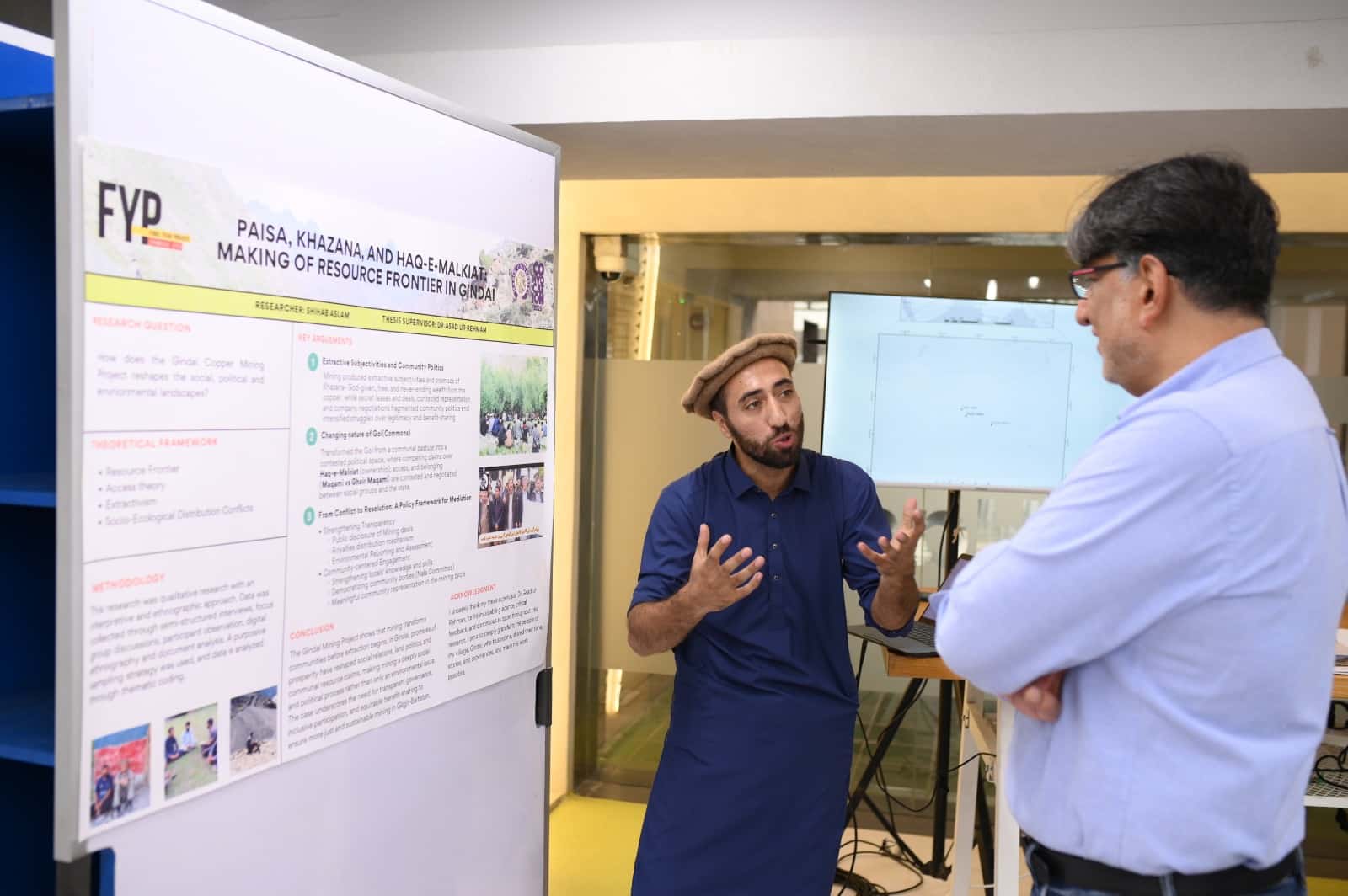
KARACHI, PAKISTAN — Habib University held its annual Final Year Project (FYP) Showcase on May 16, presenting more than 100 undergraduate research projects across artificial intelligence, climate change, gender, urban security and cultural preservation.
The exhibition drew industry professionals, writers, university donors and members of the public to view work by graduating students of the School of Arts, Humanities and Social Sciences (AHSS) and the Dhanani School of Science and Engineering (DSSE). The projects on display included art installations, social research, short films and mobile applications.
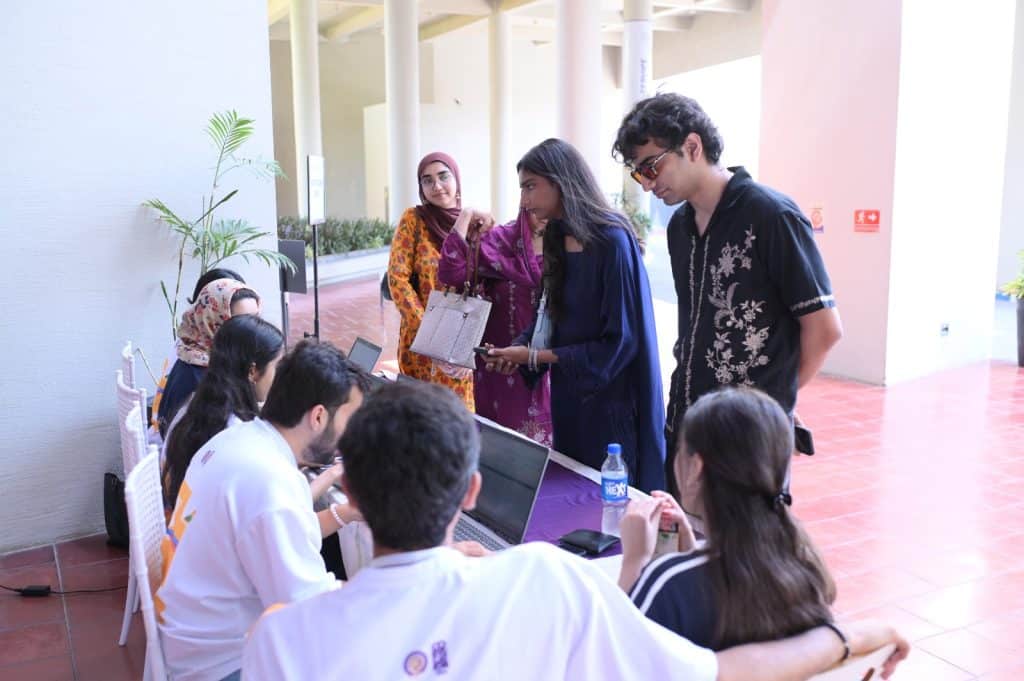
Many of the projects were grounded in the social and urban conditions of Karachi while engaging with questions of broader global relevance. Students examined the gap between technological capability and its human consequences, the ways women negotiate physical and social space in Pakistan, and the use of digital tools to preserve indigenous knowledge and local languages.
Among the projects on display was NeuroZawiya, a Computer Science project proposing a platform for neurodivergent students managing executive dysfunction. The team noted that students with ADHD and dyslexia often face a cognitive load that makes navigating complex university systems difficult, and argued for redesigning academic environments to ensure equal access.

A Social Development and Policy project, Hifazat and the Home: Negotiating Domestic Security in Karachi, Pakistan, examined the relationship between perceived threat and household security spending in the city. The researchers introduced the concept of a “Phantom Siege,” arguing that middle-class security practices reflect a cultural anticipation of catastrophe more than a measured response to actual crime, and traced how that anticipation shapes the physical form of the city’s neighbourhoods.
A Comparative Humanities project, Songs from a Burning Harmonium: Sonic Reconstruction of Identity among Afghan Refugees in Urban Karachi, took an ethnographic approach to displacement and cultural memory. The researcher documented classical Afghan melodies preserved within Karachi’s refugee community and argued that the harmonium functions as a connective object between pre-migration life in Afghanistan and the pressures of resettlement in Pakistan.

Other projects engaged with questions of governance around artificial intelligence and the design of systems intended to augment rather than replace human work.
A section of the showcase featured projects developed in partnership with industry through the Office of Takhleeq, the University’s industry-academic liaison. Collaborations with Dawlance and Toyota, among others, addressed problems including manufacturing waste reduction and fault management.
“The students have showcased really amazing projects, beyond my expectation. They have put so much effort, and they’ll surely succeed in the future,” said a parent.

The University frames the showcase as part of a broader effort to position undergraduate research in the Global South as a contributor to applied problem-solving. It argues that the conditions of Karachi — a city facing simultaneous pressures from climate change, transport stress and social fragmentation — offer a productive setting for research with relevance well beyond Pakistan.
About Habib University
Habib University is a liberal arts and sciences institution based in Karachi, Pakistan. Its interdisciplinary curriculum is grounded in the concept of Yohsin, and aims to develop graduates equipped to engage with complex social, scientific and cultural questions.

