


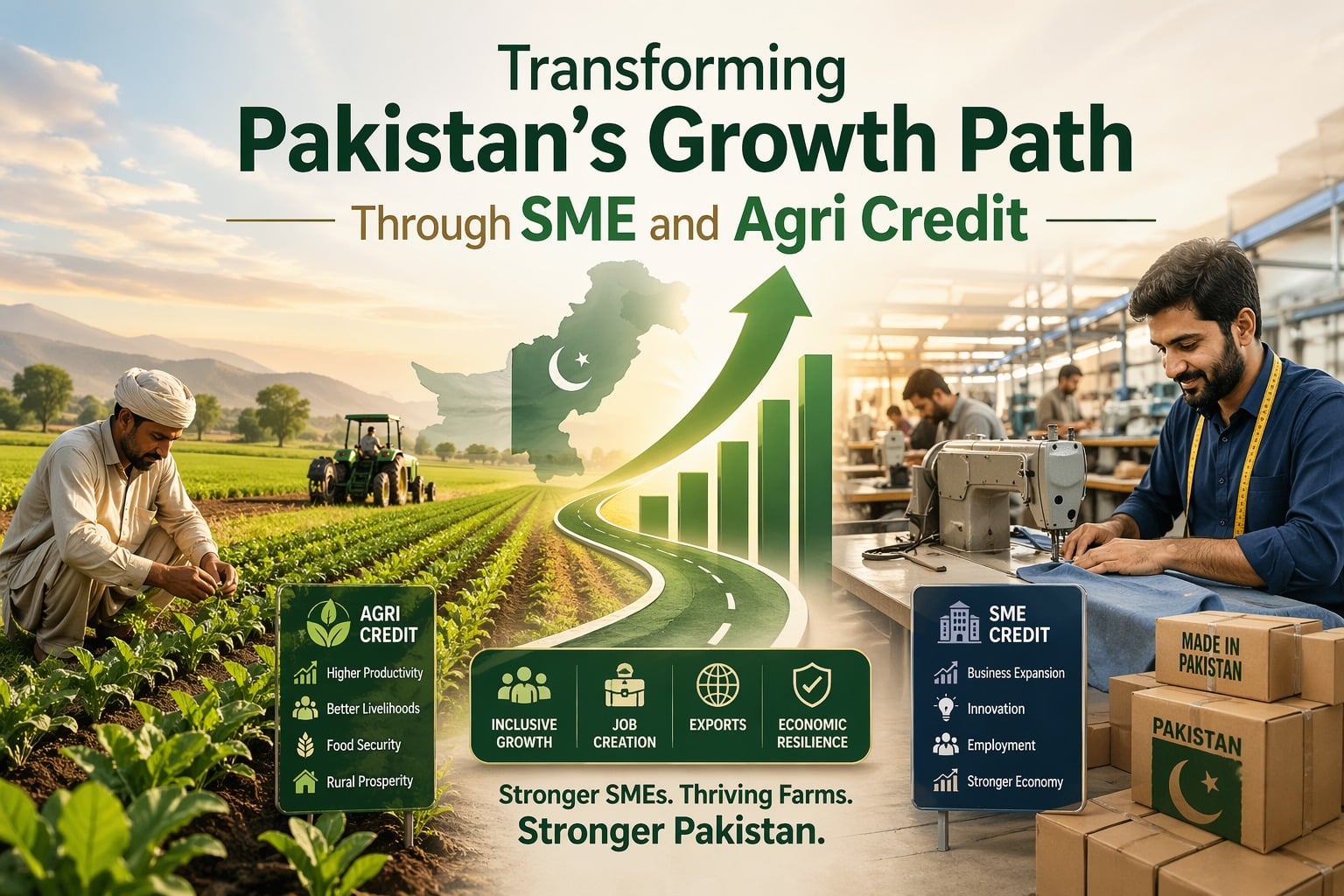
Small and medium enterprises (SMEs) and agriculture remain the twin engines of Pakistan’s economy. Together, they generate employment, stimulate both rural and urban productivity, and contribute significantly to national output. Over the past few years, financing for these sectors has undergone a notable transformation, driven by regulatory momentum, targeted monetary policy, and banks introducing diversified Shariah-compliant solutions that align with real economic needs.
According to the State Bank of Pakistan, SME financing grew by 41% in FY25, while agricultural credit rose 15%, reflecting renewed focus on underserved segments and stronger recovery from earlier economic headwinds. Agricultural credit disbursements alone reached PKR2.58 trillion, exceeding national targets and growing 16.3% from the previous year. Concurrently, the outstanding agricultural loan portfolio expanded to PKR995.3 billion, with 2.9 million active borrowers, demonstrating deeper penetration and financial inclusion across Pakistan’s farming ecosystem.
This expanding opportunity has prompted Islamic financial institutions — particularly those with extensive urban and rural reach — to introduce structured products supporting Pakistan’s entrepreneurial backbone. Among these, Faysal Bank stands out for offering a diversified suite of SME and agri-focused solutions rooted in Islamic modes of financing.
SMEs in Pakistan continue to face three core challenges: access to working capital, scalability constraints, and financing structures aligned with operational cycles. Islamic finance tools such as Murabaha, Istisna, Tijarah, Salam, and Musharakah have emerged as practical instruments for addressing these needs.
- Murabaha enables SMEs to procure raw materials, goods, or spares with predictable, cost-plus sale structures, offering short-term working capital without ambiguity.
- Istisna caters to Pakistan’s manufacturing and construction enterprises, providing flexible, order-based financing aligned with production cycles.
- Tijarah and Salam are ideal for traders, commodity handlers, and agri-linked businesses requiring advance payments or deferred delivery within Shariah guidelines.
- Musharakah allows dynamic profit-sharing arrangements where SMEs can draw and deposit funds based on evolving business requirements, aligning incentives transparently.
Complementing these traditional modes, structured supply-chain finance and trade financing platforms have become vital for SME growth. Through digital platforms and correspondent banking relationships, enterprises can now access import/export financing, guarantees, and documentary credits, connecting them more efficiently to domestic and international markets.
Agriculture, employing millions and underpinning food security, remains the backbone of Pakistan’s economy. Financing access for farmers has expanded significantly under the SBP Agriculture Credit Expansion Plans, supported by national policy, digital credit scoring, and risk mitigation frameworks. Within this landscape, Faysal Bank has developed the Faysal Khushaal Kisan scheme — a comprehensive Islamic financing suite for both farm and non-farm activities. The products cover crop production, land development, irrigation systems, farm machinery, livestock, poultry, fisheries, and renewable energy solutions like solar-powered tube wells.
Accessibility is a cornerstone of the bank’s approach. With a rural branch network and advisory services, farmers can secure financing close to their operational base, while receiving guidance to make informed decisions. Tailored facilities such as crop finance for seasonal working capital, farm development finance for silos, godowns, and irrigation, and machinery financing for tractors and harvesters demonstrate the practical application of Shariah-compliant solutions in everyday agricultural operations.
Moreover, partnerships with digital agriculture platforms like Waseela Pakistan enable fast-tracking of Shariah-compliant financing under the Electronic Warehouse Receipt framework, facilitating better liquidity management and market linkages for farmers. Initiatives extending to livestock and poultry operations, renewable energy financing, and climate-smart solutions further underline the sector-wide impact of structured Islamic finance.
Aligned with national priorities, financial institutions including Faysal Bank are increasingly integrating women-focused financial products under SBP refinance schemes. These initiatives support gender-inclusive financial ecosystems, giving female entrepreneurs and farmers equitable access to capital and contributing to broader socioeconomic development.
Pakistan’s SME and agriculture sectors are now entering a phase of enhanced institutional support, regulatory alignment, and digitization. As banks continue to innovate, leverage Shariah-compliant structures, and expand outreach to underserved segments, financing access is poised to grow, creating a multiplier effect on employment, productivity, and rural-urban economic linkages.
For Pakistan, SMEs and agriculture are more than economic sectors; they are foundational pillars of sustainable growth. By offering accessible, Shariah-compliant financing solutions, institutions like Faysal Bank are not only meeting immediate credit needs but also fostering resilience, enabling entrepreneurship, and contributing directly to national economic stability.
By Zunaib Khanzad

