


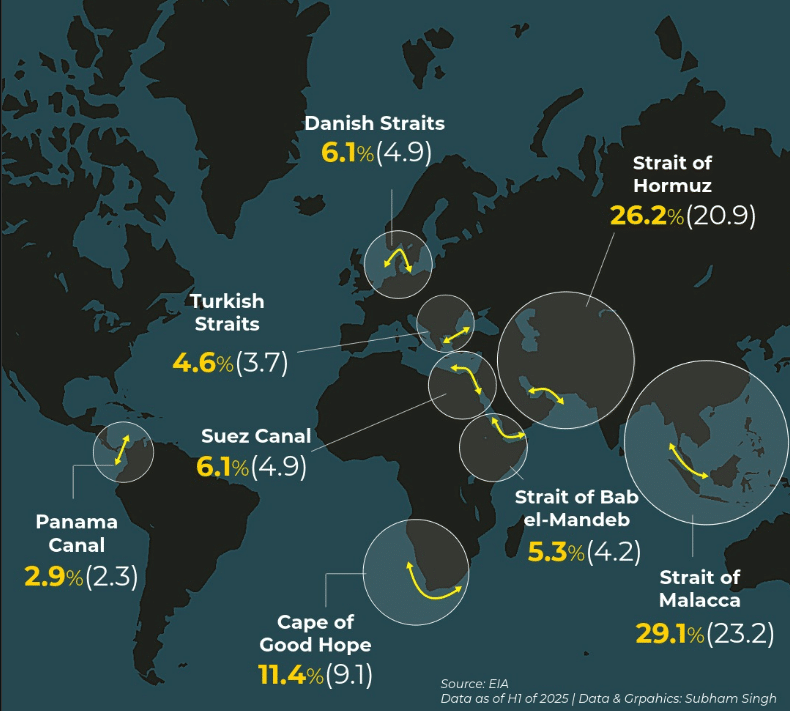
More than 90% of the world’s oil trade passes through a few narrow sea routes known as chokepoints. These routes are critical for global energy supply, and any disruption can affect fuel prices and availability worldwide.
Below are the eight major oil transit routes highlighted in global shipping data:
Strait of Malacca
This is the busiest oil route in the world, handling around 29 percent of global oil trade. It connects the Indian Ocean with the Pacific Ocean and is vital for Asian economies.
Strait of Hormuz
About 26 percent of global oil passes through this route. It is a key link for oil exports from the Middle East to global markets.
Cape of Good Hope
This route carries over 11 percent of the oil trade, often used as an alternative when other routes face disruption.
Suez Canal
Handling around 6 percent of global oil, this canal connects the Mediterranean Sea to the Red Sea, reducing travel time between Europe and Asia.
Danish Straits
These waterways carry about 6 percent of oil, linking the Baltic Sea with the North Sea.
Strait of Bab el-Mandeb
Around 5 percent of oil flows through this route, which connects the Red Sea to the Gulf of Aden.
Turkish Straits
These straits handle nearly 4.6 percent of global oil, linking the Black Sea with the Mediterranean.
Panama Canal
Though smaller in share at around 3 percent, it remains important for trade between the Atlantic and Pacific oceans.
These chokepoints are essential for global energy flow, and any blockage or conflict in these areas can quickly impact oil prices and supply chains worldwide.

