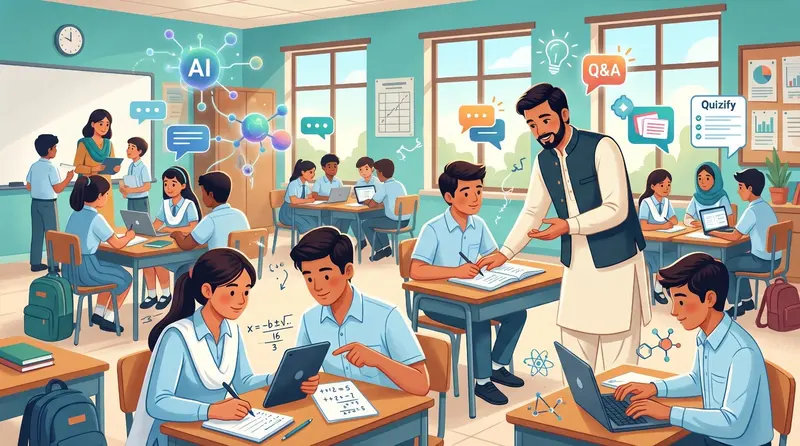
A little help from AI is changing how classrooms learn
Every student has their own way of understanding lessons. Some need an explanation in simpler words, others learn better through visuals, while some need a little more practice before a concept clicks. But with a full classroom and limited time, giving every student individual attention can be challenging. AI is opening up new possibilities, helping teachers support different learning needs while making lessons more engaging.
The everyday challenge of teaching
For teachers, helping every student understand a lesson is not always straightforward. A concept that makes sense to one student may leave another confused. Some need an explanation repeated, while others need to see an example or try a few questions before they feel confident. And when students return home to revise, they may find themselves struggling with questions they could not fully understand in class.
Zeeshan Ali, a Maths teacher, sees this regularly. Students may know a formula but still struggle to apply it to a problem. For him, teaching math is not simply about helping students reach the correct answer. It is about making sure they understand the steps and can use the same method when faced with a similar question.
Hira Hussain, a Chemistry teacher at the same school, faces a different kind of challenge. Some scientific concepts can be difficult to understand through written explanations alone. Topics such as molecular structures, chemical bonding and reactions often become easier to follow when students can see how they work.
“Sometimes, students can read a definition several times and still struggle to understand it. But when they can see how something works, the concept becomes much clearer,” she explains.
Both teachers highlight an important part of learning: students do not always need the same explanation. They need different ways to approach a topic, depending on what they find difficult.
Finding another way to understand
This is where digital learning resources can offer additional support. Students can revisit a topic, explore an explanation at their own pace and spend more time on areas they find challenging. AI-powered tools are adding to these possibilities by allowing learners to ask questions and receive explanations beyond the classroom.
One such platform is Gauth, an AI-powered learning resource that Zeeshan has introduced to his students. Its AI Tutor allows learners to ask follow-up questions and explore difficult topics through simpler explanations. For students who struggle to work through math problems, this can provide another way to understand the steps involved.
Zeeshan, however, is clear that finding a solution should not be the end of the exercise. He encourages students to read through the explanation, understand the method, put the solution aside and attempt a similar question independently. If they still have difficulty, they can bring it to class for further discussion.
“Sometimes, students don't need the same explanation repeated. They just need someone to explain it in a way that makes sense to them,” he says.
Visual learning can be equally useful in subjects such as Chemistry. While Hira highlights the value of seeing how scientific concepts work, Gauth Atlas offers web-based visual illustrations that can help learners explore complex topics. It provides another way to approach concepts that may be difficult to picture through text alone.
The platform also includes tools designed for revision. Quizify turns study material into practice quizzes, Flashcards help students review key concepts, and TLDR creates shorter summaries of lengthy study material. These resources offer different ways to revisit information, depending on how students prefer to study.
For Zeeshan, the benefit is not about making the teacher less involved. It is about helping students return to the classroom with a clearer idea of what they understand and where they need help.
“I still want my students to come to me with questions. But now, they sometimes come with a better idea of what they are struggling with. That makes our classroom discussions more useful.”
The teacher remains at the heart of learning
As AI becomes part of the learning process, how students use these tools matters just as much as the support they provide. Having an explanation readily available does not mean students should stop thinking through a problem or rely on technology for every answer. They still need guidance to question information, understand concepts and develop their own problem-solving skills.
Ms Sana Ahmed, a senior teacher at the school, believes AI can be a useful learning resource when students are encouraged to use it thoughtfully.
“I think AI can be a great help for students, especially when they are trying to understand a topic they find difficult. It gives them the chance to go over a lesson, practise questions and learn at their own pace. I've seen how Zeeshan uses Gauth to help his students without letting them depend on it for every answer. Even our principal appreciated this approach because students are getting support while still learning to think and solve problems on their own,” she says.
Her perspective underlines the importance of balance. Technology can provide additional explanations and opportunities to practise, but teachers continue to play a central role in helping students make sense of what they learn. Their guidance, experience and understanding of individual students cannot simply be replaced by a digital tool.
Learning beyond the classroom
Having another way to understand a difficult topic can make independent study easier for students. It allows them to revisit concepts, work through challenging questions and practice at their own pace. It can also help them come to class better prepared, with a clearer idea of what they understand and where they need their teacher's support.
Arham, a Grade 9 student, says step-by-step explanations help him prepare for his Maths lessons.
“Sometimes I know the formula, but I'm not sure how to apply it to a problem. Going through a step-by-step explanation helps me understand where I'm getting stuck. When I discuss it with my teacher, I can ask more specific questions and understand the method better,” he shares.
For Ammarah, a Grade 10 student, having different ways to explore a topic makes learning easier.
“Sometimes, reading a topic in a textbook is not enough to understand it fully. Whether it is a difficult concept, a new topic, or a problem I need to practice, having an explanation in a different way helps me understand the basics before class. It also makes it easier to follow my teacher's explanation and ask questions about anything I find confusing,” she says.
Their experiences show how AI-supported learning can complement classroom teaching across different subjects. By helping students revise concepts, practice questions and explore topics in different ways, these tools can prepare them to take a more active part in class. They can come to lessons with a better understanding, ask more relevant questions and make the most of their teachers' explanations and guidance.
Bringing new learning opportunities to more classrooms
The potential of digital learning resources extends beyond individual classrooms. Under an agreement with the government, Gauth is set to provide more than 4,000 free teacher subscriptions across Pakistan, including 1,000 for educators at government-backed Daanish Schools.
The initiative aims to give more teachers access to digital resources that can complement their existing teaching methods and provide additional support for students.
As technology continues to find its place in education, the focus should remain on how it can improve the learning experience without taking away from the role of teachers. An AI tool may offer another explanation, a visual example or an opportunity to practise, but students still need the curiosity to ask questions and the guidance to understand the answers.
Ultimately, learning is not about finding the quickest route to a correct answer. It is about understanding the process, building confidence and being able to work things out independently.
AI may help a student look at a difficult question differently. But the real progress comes when that student can put the tool aside, work through the problem and say, “I think I understand it now.”
Author: Laiba Sheikh
Bio: Laiba is a Mass Communication graduate from the University of Karachi and a Teacher with an interest in media, communication and storytelling.
Share this story
Send it to someone who should read it.