


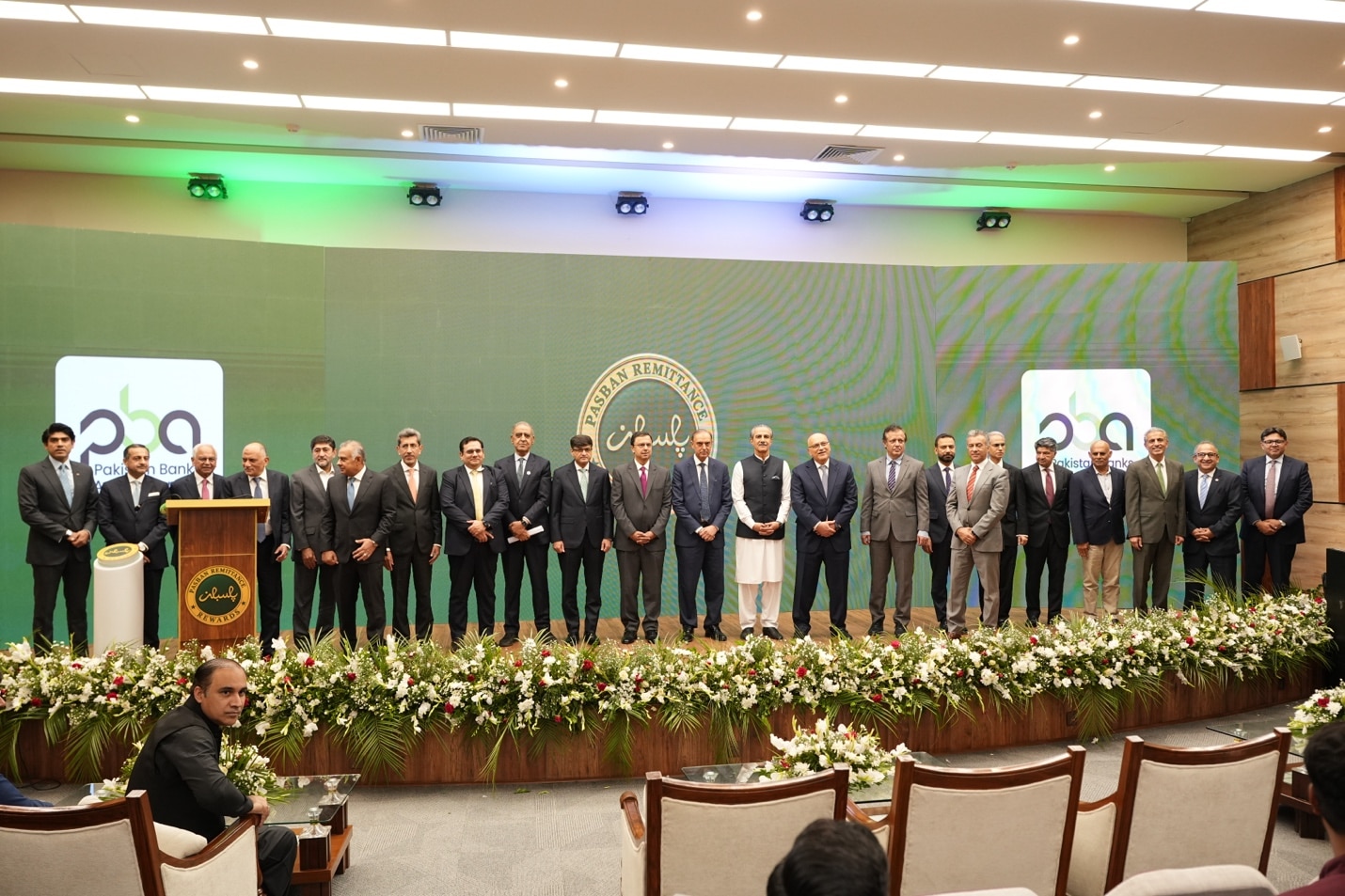
The country’s banking industry, jointly with the State Bank of Pakistan (SBP) and under the aegis of the Pakistan Banks Association (PBA), launched the Pasban Remittance Rewards, a nationwide incentive scheme designed to recognise the invaluable contribution of overseas Pakistanis while encouraging greater remittance flows through formal banking channels.
The Scheme was announced at a launch event at the SBP, chaired by Mr Jameel Ahmad, Governor, SBP, in the presence of senior bankers and government officials.
Governor SBP said the SBP and the Government have been working closely with the PBA over the past few months to develop a self-sustaining and market-oriented remittance scheme that can continue to facilitate, encourage, and attract workers’ remittances from overseas Pakistanis through formal channels. He emphasized that workers’ remittances are the backbone of millions of families across Pakistan. They help meet household expenditures, support education and healthcare, and provide resources for investment and economic opportunity.
The Governor also highlighted the substantial strengthening of the country’s external account position. He noted that the external current account deficit, which had reached unsustainable levels in FY22 – causing a rapid depletion of foreign exchange (FX) reserves, has now been brought to manageable levels, supporting a sustained buildup in FX buffers. SBP’s FX reserves, which fell below US$3.0 billion in February 2023, now stand at US$21.4 billion. He stated that, unlike in the past, the continued strengthening of FX buffers has been driven primarily by FX purchases from the market rather than an accumulation of external debt. The Governor appreciated the contributions of overseas Pakistanis and highlighted the exceptional performance of workers’ remittances, which reached a record US$41.6 billion in FY26, compared with US$21.7 billion in FY19, nearly doubling over the period.
Briefing participants on the initiative, Mr Muneer Kamal, CEO & Secretary General, PBA, said qualifying remittances make beneficiaries automatically eligible for quarterly draws from January 2027, with a prize pool of Rs. 4 billion per quarter (Rs. 16 billion a year), funded by the banking industry, with governance mechanisms developed in consultation with SBP.
This builds on the remitter incentive banks have funded since July 2026, previously borne by the Federal Government, now around Rs. 80 billion a year, bringing the industry’s combined annual commitment to close to Rs. 100 billion, aligned with the Government’s remittance objectives.
The Scheme is the latest in a series of coordinated steps by SBP, the Government and the industry to support the external sector. Earlier this year, banks voluntarily cut the Export Refinance Facility markup by 3.0 points to 4.50% on new loans and rollovers, within the PKR 1,052 billion ERF limit, supporting the Government’s export-led growth agenda alongside the Export-Import Bank’s financing for export SMEs.
Private and priority-sector financing has also improved markedly, aided by SBP’s monetary easing and the PM’s Access to Finance Plan 2026-28: private credit rose to PKR 1.46 trillion in FY26 (+35%), agricultural credit hit a record PKR 3.23 trillion (+24.7%), SME financing reached PKR 1.07 trillion, and housing finance crossed PKR 300 billion. The industry has committed to PKR 1.5 trillion each in agri/SME financing by June 2027, and PKR 2 trillion each by June 2028.
Beyond lending, the industry has worked alongside SBP and the Government on circular-debt resolution and PIA’s privatisation, while investing in digital channels, Islamic banking and financial inclusion.
Mr Zafar Masud, Chairman, PBA, said: “Pakistan’s banks have consistently stepped up, taking over the Rs. 80 billion remitter incentive, cutting export refinance rates for our exporters, taking private, agricultural and SME lending to record levels, and supporting circular debt resolution. Overseas Pakistanis are an equally important part of this story, and the Pasban Scheme recognises their contribution, in partnership with SBP and the Government.”

