


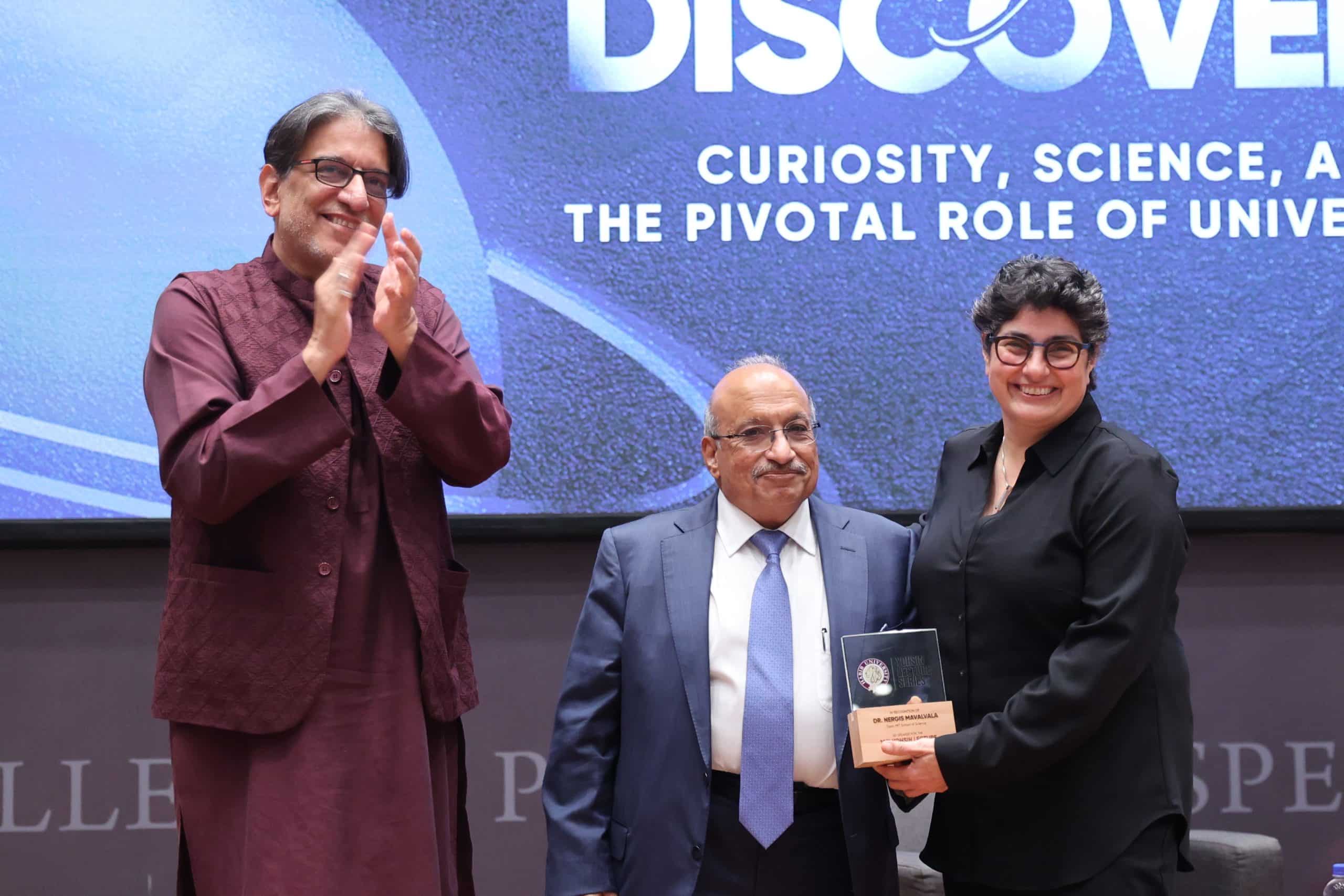
Habib University was honoured to host Dr. Nergis Mavalvala, Dean of the School of Science at the Massachusetts Institute of Technology, as the tenth speaker in its Yohsin Lecture Series. Dr. Mavalvala delivered her lecture, titled The Joy of Discovery: Curiosity, Science, and the Pivotal Role of Universities, to a full auditorium of students, faculty, alumni, industry leaders, and Pakistan’s wider scientific community, closing a two-day visit to the University that marked a high point in Karachi’s intellectual calendar.
In her lecture, Dr. Mavalvala asked why human beings seek knowledge at all, especially knowledge with no obvious use. She reflected on humanity’s appetite for curiosity, stating, “Even pre-human cultures were looking up at the sky, in part because it was just mysterious. A hundred years from now the only thing that will matter is that we’ve opened a new window into the universe.’” Pushing back against the idea that curiosity must justify itself in advance, she argued that some of the most consequential discoveries began as questions with no obvious payoff, and that universities carry a responsibility beyond training professionals, to cultivate wonder, creativity, perseverance, and intellectual freedom.
“[ Many, many thanks to [President] Wasif and colleagues at Habib University, to the board, to the Mohsineen who made this place possible. Everything I’ve done here has told me that your vision and your generosity was every bit worth it. I’ve met with a number of students and alumni and just have been wowed. ],” she told the audience.
President Wasif Rizvi spoke of what her presence signifies for the University community, particularly the Mohsineen who continue to extend their generosity to make a world-class education accessible to all who deserve and seek it.
“[I have professional sympathy as well for the detection of faint signals, as the president who raises funds for the most generous private university in the country. Access of this kind had not been attempted in Pakistan before. It exists because the community in this room and outside decided that it should. The students in this hall are the answer to anyone who asks what it is that philanthropy can do.],” he said.
The lecture capped two days of sustained engagement across the University. Dr. Mavalvala toured the campus with the Habib University team, held a substantive conversation with faculty on nurturing curiosity in the classroom, and met with outstanding science and humanities students drawn from leading schools across Karachi. She spent exclusive time with Habib University’s own students and alumni, and joined sessions with the Entrepreneurs’ Organization, as well as Pakistan’s wider scientific community to strengthen a shared commitment to investment in homegrown scientific and academic excellence. Her conversations with University leadership went beyond the immediate, touching on how a unique liberal-arts undergraduate institution like Habib can continue to cultivate students’ appetite for curiosity, and on the enduring joy of teaching and mentoring itself.
Following the lecture, an extended question-and-answer segment drew attention to key challenges in the national context, with Dr. Mavalvala noting, “Every single person at birth is research-minded. The reason some of us get to do it in adulthood is [access to] opportunity. Research has shown there is no investment that any government does that has greater return than investment in research and science.”
The tenth edition of the Yohsin Lecture was, by the University’s account, among the most widely attended in the series’ history, and a fitting mark of a milestone in a flagship lecture series built on Habib’s founding philosophy of Yohsin, the thoughtful cultivation of the self. The University’s pioneering tradition of bringing the world’s leading thinkers to Pakistan for intellectual engagement has brought Karachi into dialogue with the leading minds of our times including Noam Chomsky, Ashis Nandy, Reza Aslan, Azra Raza, and Thomas Blom Hansen. Attendees included students, faculty, alumni, distinguished academics, and prominent members of Karachi’s broader cultural, scientific, and entrepreneurial community, many of whom carried the discussion forward at the reception on the University’s Central Street, continuing conversations the lecture had opened.
About Habib University
Habib University is Pakistan’s premier liberal arts and sciences university. Founded in Karachi in 2014, it offers a contextually rooted education with a global outlook, grounded in its philosophy of Yohsin and bringing together the sciences, engineering, arts and humanities. The University is a candidate for accreditation with the New England Commission of Higher Education (NECHE).

