


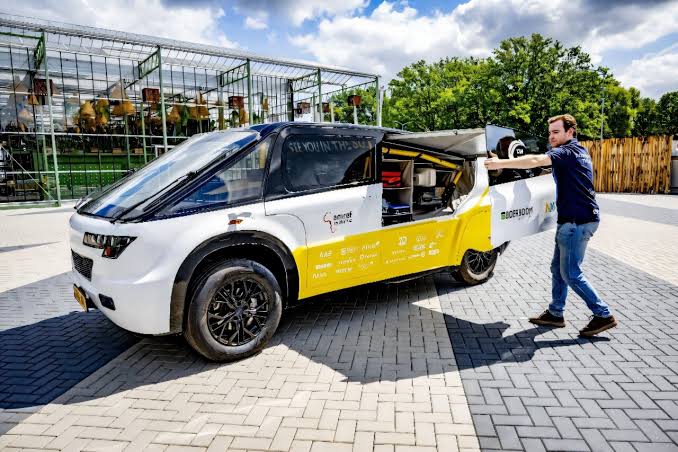
Students from Eindhoven University of Technology have introduced Stella Juva, a solar-powered ambulance designed to bring healthcare services to people living in remote and hard-to-reach areas.
The vehicle is powered by solar panels installed on its roof and a 50 kWh battery. On sunny days, it can travel up to 715 kilometres while also supplying electricity to important medical equipment inside the ambulance. This allows healthcare workers to provide medical services even in places where access to electricity is limited.
Unlike traditional ambulances, Stella Juva is not mainly designed to transport patients to hospitals. Instead, it takes healthcare directly to local communities.
Medical staff can use the vehicle to provide vaccinations, perform blood tests, carry out pregnancy ultrasounds, and conduct disease screenings. The goal is to make essential healthcare available to people who live far from hospitals and clinics.
The project was developed by students who wanted to combine clean energy with healthcare innovation. By using solar power, the ambulance reduces fuel costs and lowers carbon emissions, making it a more environmentally friendly solution for medical services.
The team plans to begin field testing the vehicle in Kenya, where access to healthcare can be difficult in some remote areas. The trials will help researchers evaluate the ambulance’s performance in real-life conditions and identify any improvements needed before wider use.
After the testing phase, Stella Juva will be showcased in different European countries to demonstrate its technology and encourage the adoption of sustainable healthcare solutions.
The project highlights how renewable energy and modern engineering can work together to improve medical care, especially for communities that have limited access to healthcare facilities and essential services.

