


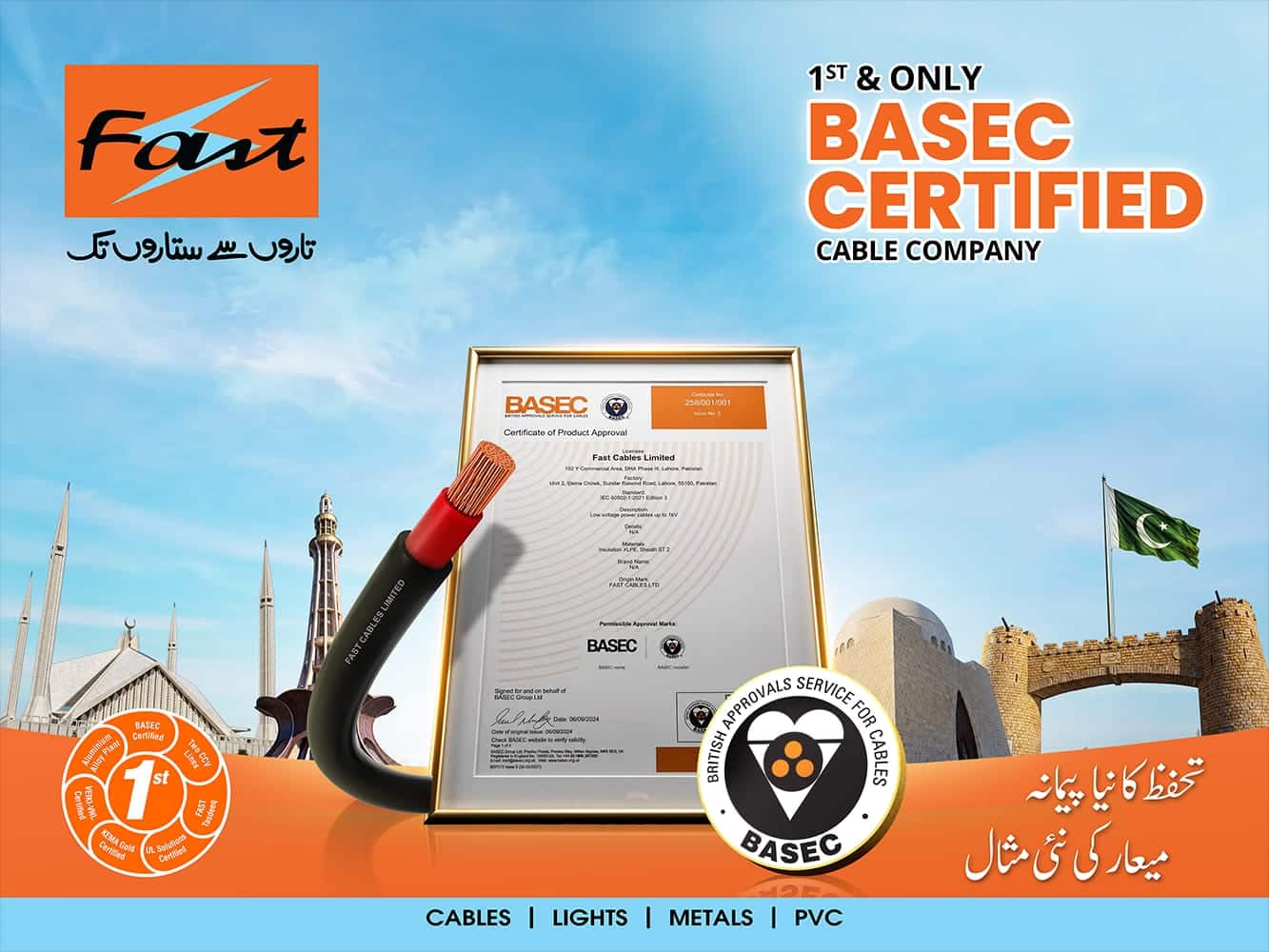
It’s always encouraging to see Pakistani companies take meaningful steps that raise the bar for the local industry. I recently came across FAST Cables achieving BASEC certification, making it the first cable manufacturer in Pakistan to achieve this certification. For an industry where product reliability, safety, consistency, and long-term performance are critical, this is an important development that deserves recognition.
What stood out to me most is that BASEC certification is not simply about putting another certification mark on a product. It represents a more comprehensive approach to quality and manufacturing standards. BASEC, the British Approvals Service for Cables, is an independent certification body known for assessing cable manufacturers against rigorous technical and quality requirements. This kind of independent assessment adds a different level of credibility because the process is not based solely on a company’s internal claims about its products.
For customers, this distinction matters.
Cable is one of those products that often remains invisible once it becomes part of a building, infrastructure project, industrial facility, or electrical system. Yet its performance can have significant consequences. The quality of a cable affects safety, reliability, energy efficiency, maintenance requirements, and the overall life of an electrical installation. A product may look perfectly acceptable from the outside, but its real value is determined by what is inside, how consistently it is manufactured, and how it performs under demanding conditions.
This is where independent certification becomes particularly relevant.
What makes BASEC certification meaningful is the emphasis on evaluating not only the finished product but also the manufacturing process and quality systems behind it. Independent verification can provide greater confidence that the required standards are being followed consistently rather than being achieved only during a particular production run.
For manufacturers, achieving such certification is therefore not just a marketing milestone. It requires investment, discipline, process control, documentation, testing, and continuous attention to quality. Maintaining those standards is arguably just as important as achieving the certification in the first place.
For Pakistan’s cable industry, this can have broader implications.
The local manufacturing sector has developed considerably over the years, with Pakistani companies increasingly competing on quality, technology, capacity, and innovation. However, one of the challenges faced by local manufacturers is the perception gap between locally produced products and internationally recognized standards. Independent certifications can help address that gap by providing customers, consultants, contractors, developers, and institutional buyers with an additional benchmark for evaluating products.
In other words, certifications such as BASEC can help shift the conversation from simply asking, “Where is this product made?” to asking, “What standards does this product meet, and how independently has that been verified?”
That is a much healthier direction for the industry.
It can also encourage greater competition among manufacturers. When one company raises its standards and obtains internationally recognized certification, competitors are likely to face increased pressure to improve their own manufacturing processes, testing capabilities, quality systems, and customer assurance. Over time, this can contribute to an overall improvement in industry standards.
There is also a potential export dimension.
As Pakistani manufacturers look beyond the domestic market, internationally recognized certifications can become an important part of establishing credibility. Export markets often have strict technical requirements, and buyers may prefer suppliers whose products have been independently assessed against recognized standards. While certification alone does not guarantee export success, it can remove one of the barriers that manufacturers face when attempting to enter more demanding markets.
For the customer, the ultimate benefit should be confidence.
When someone invests in an electrical product, they are not simply buying copper, insulation, or a finished cable. They are buying reliability over time. They expect the product to perform consistently, withstand the conditions for which it was designed, and contribute to the safety of the overall electrical system.
Independent certification can strengthen that confidence because it provides an external layer of assurance.
At the same time, it is important not to treat certification as the end of the journey. A certificate should not become a substitute for continuous quality management. Manufacturing standards, testing procedures, raw-material controls, process monitoring, product traceability, and after-sales accountability all remain important. The real value of a certification is sustained when the organization continues to operate at the standard that earned it.
This is also where leadership and organizational culture matter. Quality cannot be limited to the quality-control department. It needs to be embedded across procurement, manufacturing, engineering, testing, supply chain, sales, and customer service. When quality becomes part of the organizational culture rather than simply a compliance requirement, the impact becomes much more meaningful.
FAST Cables achieving BASEC certification, therefore, represents more than an individual company milestone. It is also a signal that Pakistani manufacturing has the potential to meet benchmarks that are respected beyond our domestic market.
For the local industry, this should be viewed as healthy progress. The objective should not simply be to collect more certificates or display more logos. The real objective should be to build products and processes that consistently earn customer trust.
That is ultimately what raises the bar.
If more Pakistani manufacturers continue investing in internationally recognized standards, independent testing, technology, innovation, and robust quality systems, the benefits can extend well beyond individual companies. It can strengthen the reputation of Pakistani manufacturing, improve customer confidence, encourage healthier competition, and create opportunities in international markets.
FAST Cables being the first cable manufacturer in Pakistan to achieve BASEC certification is therefore worth noting—not simply because of the certification itself, but because of what it represents.
It represents a willingness to subject local manufacturing to independent scrutiny and to demonstrate that Pakistani products can be measured against demanding international benchmarks.
For an industry where reliability and safety really matter, that kind of verification can make a meaningful difference.
And perhaps the bigger takeaway is this: Pakistan does not only need more manufacturing capacity. It needs more manufacturing excellence. Certifications such as BASEC can play a role in proving that the two can go hand in hand.

