Four Pakistan–China Experiments Head to Orbit on Shenzhou-24
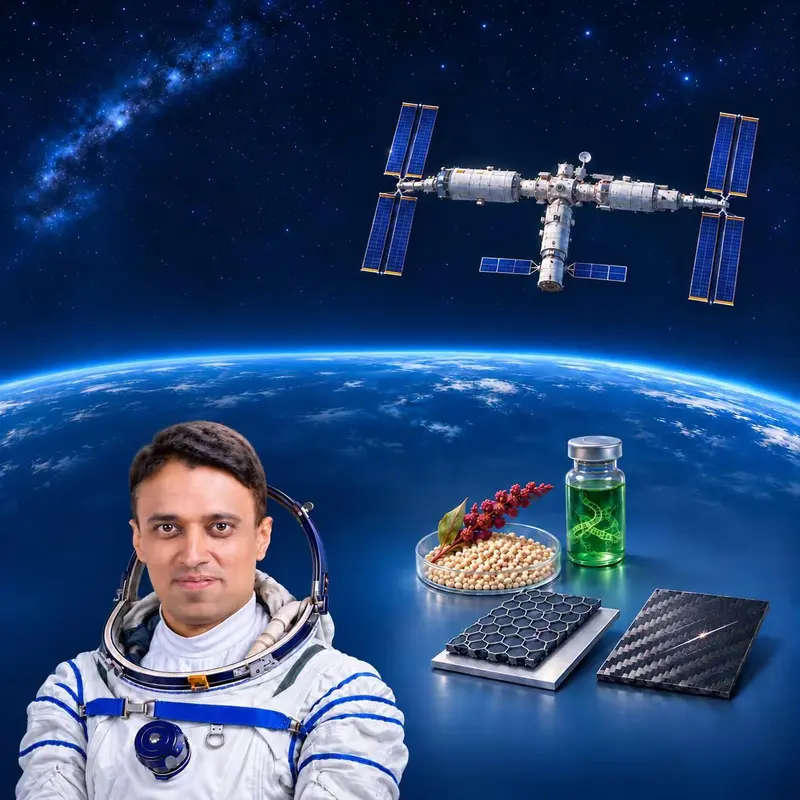
Pakistan’s first astronaut reached China’s Tiangong space station on 25 November. His arrival also marks another first: Tiangong will host joint experiments by Pakistan and China, including two designed to run for nearly a year outside the station.

Pakistan’s first astronaut reached China’s Tiangong space station on 25 November. His arrival also marks another first: Tiangong will host joint experiments by Pakistan and China, including two designed to run for nearly a year outside the station.
Here’s what Pakistani scientists are testing:
- 🌱 What does space do to seeds? A team at the University of Agriculture Faisalabad sent 32 quinoa seed samples into orbit and kept a matching set on Earth. Comparing the two will help researchers see whether space exposure changes how long the seeds can still sprout or affects their nutritional value.
- 🫧 Could microbes help astronauts breathe? A team co-led by Pakistan’s Jawad Nasir will study how well cyanobacteria grow and absorb carbon dioxide in orbit. The tiny organisms release oxygen as they grow, which could make them useful on longer missions.
- 🛡️ Is there a better way to shield spacecraft? Researchers will place a graphene-based material and aluminium of the same weight per unit area outside Tiangong to see which blocks more radiation.
- 🔧 Can spacecraft materials repair themselves? Another team will use images from orbit to see whether scratches in a carbon-fibre composite close as the material repeatedly heats up and cools down.
Both materials tests will continue long after Muhammad Zeeshan Ali returns to Earth. The samples will be brought back for analysis.
Share this story
Send it to someone who should read it.
Join the conversation
Comment rules