What If the Next Era of Computing Takes Shape in Pakistan?
As AI moves beyond chatbots, a new question is emerging: what if software could reorganize itself around what people want to achieve?
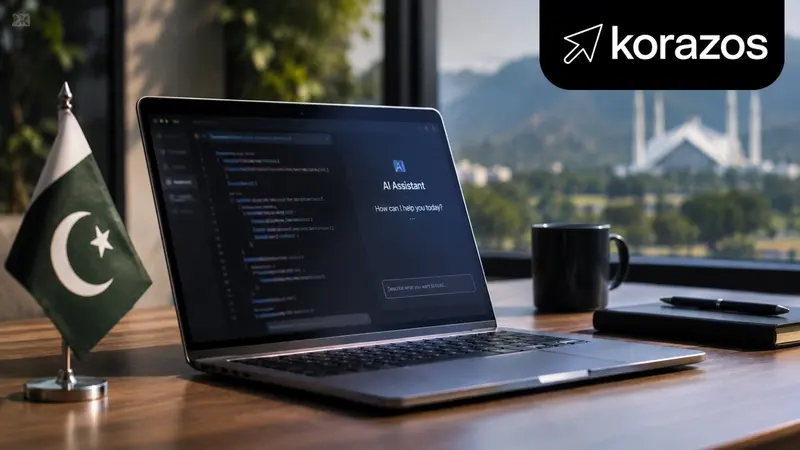
As AI moves beyond chatbots, a new question is emerging: what if software could reorganize itself around what people want to achieve?
For decades, using a computer has meant learning the language of applications. Open a spreadsheet to analyze numbers. Switch to a browser to gather information. Move to a document editor to write up the findings. Repeat the process whenever the task changes.
Artificial intelligence has made some of those individual steps faster. Yet the larger experience remains remarkably familiar: people still assemble their own digital workflows, moving between tools that rarely fit together as naturally as the work demands.
Now a different possibility is beginning to attract attention. What if people could describe an outcome, and the computing environment could assemble the interfaces, tools and processes needed to pursue it?
When the task becomes the starting point
Today’s AI assistants can summarize documents, generate code and help interpret data. But an answer in a chat window is not necessarily a usable working environment. A person may still need to copy results elsewhere, configure software, check permissions and supervise several disconnected steps.
The emerging idea of adaptive computing asks whether that separation must remain. Rather than offering every user the same fixed interface, a system could generate a workspace shaped by a particular goal. A researcher might need source material, a comparison view and a way to track evidence. A developer might need code, test results and system logs. An operations team might need a dashboard built around the decisions it actually faces.
The point would not be to eliminate every existing application. Specialized tools often offer precision and reliability that generic systems cannot easily match. The more interesting possibility is that accessing and combining capabilities could become less dependent on manually navigating between them.
A computing question being explored from Pakistan
This line of thinking is also being explored by founders from Pakistan. One early-stage effort, Korazos, is developing an AI-native computing runtime intended to turn a user’s objective into a purpose-built, interactive workspace.
In the approach the team is investigating, the system would connect appropriate tools, generate interfaces and coordinate tasks within isolated execution environments, while retaining approval points for consequential actions. It is a different design challenge from simply placing a chatbot inside an existing application: the workspace itself becomes part of what the system creates.
The project is still at prototype stage. Whether such an approach can become reliable and useful at scale remains an open question. But the engineering ambition is notable because it addresses an increasingly important gap between what AI models can do and how people actually use software.
Why the difficult questions matter
A computer that constructs a workspace on demand must do more than produce an appealing interface. It must interpret instructions correctly, access information within clear boundaries, handle failures and allow people to understand what is happening.
Consider a system that can retrieve data, run an analysis and prepare a result. Which sources may it access? When should it ask permission? How can a user inspect its reasoning, correct a mistake or stop an unwanted action? The answers will determine whether adaptive workspaces become dependable tools or remain impressive demonstrations.
These challenges bring several disciplines together: interaction design, software architecture, security, orchestration and human oversight. They also explain why the future of AI-powered computing is unlikely to be settled by model performance alone.
Beyond the familiar story of Pakistan’s tech sector
Pakistan’s technology conversation has often centered on software services, outsourcing, freelancing and the talent of its engineering workforce. Those contributions are important. Yet there is another question worth asking: can more teams based in Pakistan help shape the underlying products and infrastructure that people around the world use?
Developing original technology brings risks that service-based work does not always carry. Research takes time. Technical assumptions must be tested. Funding, experienced mentorship and access to markets can be difficult to secure. And a compelling idea is not the same thing as a product that people will adopt.
Still, the ambition to work on foundational problems matters. As AI changes the tools available to developers, the ability to experiment with new forms of software is becoming more widely distributed. The opportunity is not simply to implement the next global technology wave, but to participate in defining it.
For the founders behind Korazos, that means exploring both sides of the problem: the interfaces people interact with and the runtime systems needed to make those interfaces useful and controlled. Their work is one example of a broader opportunity for Pakistani builders to move from assembling software solutions toward examining the assumptions beneath software itself.
The next interface may begin with a question
Previous computing shifts changed who could use technology and how. Graphical interfaces reduced the need to memorize commands. The web connected information and services. Smartphones made computing an everyday companion.
Adaptive computing, if it proves practical, could shift the starting point once again: from choosing an application to describing an intention. That does not mean the desktop, browser or app will vanish. It means the boundaries between them could become less important than the outcome a person is trying to achieve.
No one yet knows which designs will succeed, or how quickly they might become commonplace. But the questions are now concrete enough for engineers to build and test possible answers.
And some of those questions are being asked in Pakistan—not only about how to use the next generation of software, but about what that software might become.
Share this story
Send it to someone who should read it.