Chinese Sensors Help NVIDIA Teach Robots to Grip
A robot struck a match and lit a lamp. It learned the move from a person wearing sensor-covered frames over both hands, and every touch sensor in those frames comes from a Chinese company.
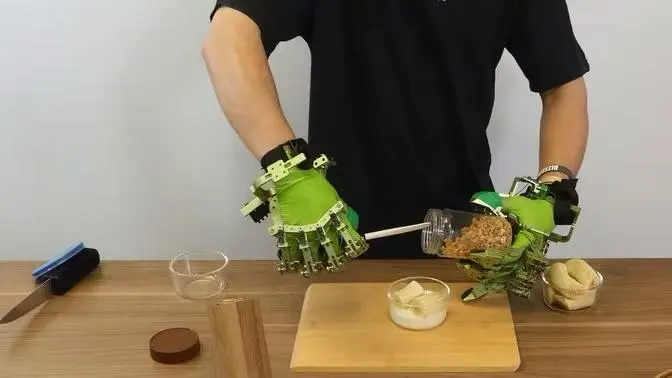
A robot struck a match and lit a lamp. It learned the move from a person wearing sensor-covered frames over both hands, and every touch sensor in those frames comes from a Chinese company.
NVIDIA showed the result on 9 November, when it released GR00T 2, an open robot AI model.
The device, GEAR DexUMI, carries touch sensors from China's Tashan Technology on every fingertip and palm, according to NVIDIA's published parts list. The fingertip sensors record how hard the wearer presses and slides during a task. Encoders track each joint and wrist cameras film the scene. No robot needs to be present.
Why does that matter? Think of a ripe mango. Grip too lightly and it slips; too hard and it bruises. A robot needs data showing how hard to press.
NVIDIA says the robot also learned to prepare banana yoghurt and scoop granola this way. Separately, it says five demonstrations per task lifted the model's success rate on 50 unfamiliar tasks from 40 per cent to 95 per cent.
Tashan was already present in NVIDIA's software. The Isaac Sim robotics platform includes a simulation model of one of its sensors, and DexUMI extends that to hardware.
DexUMI's designs and assembly guides are public, along with 100,000 hours of first-person human video.
Any use in Pakistan would need its own training data and robot hardware. Which job would you teach a robot first: packing mangoes without bruising them, or handling fabric without pulling it out of shape?
Share this story
Send it to someone who should read it.